
Mastering Open Stance Range: Southpaw vs Orthodox Distance Rules
Southpaw vs Orthodox Distance Rules: How to Control Open Stance Range
You can spend a career reading distance against like stances, but step into an open stance affair and the rulebook is all but rewritten. The jab that has been your most reliable tool for years will not land clean; it will run right into the other man’s lead hand. And the pocket you have considered safe for ten years is now the most hazardous ground in the ring.
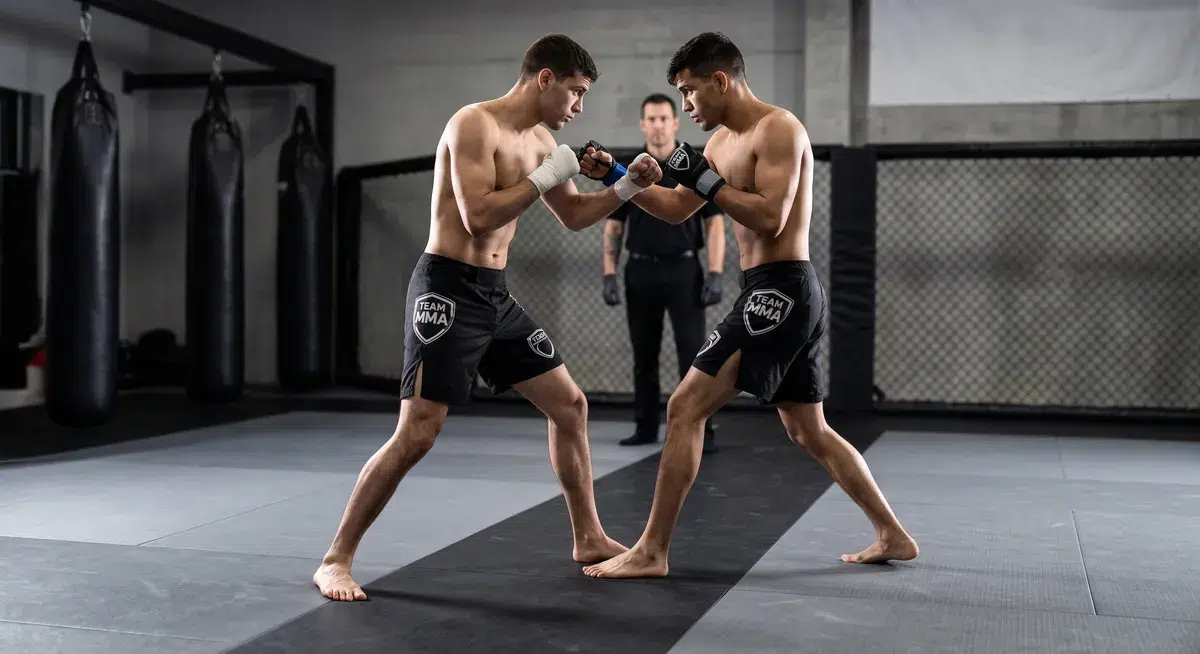
The geometry of a southpaw versus orthodox contest is simply not the same as closed stance management. Mirrored lead hands and feet redefine what is at a safe remove. Here we explain why the conventional jab is useless in this context, how to let your lead hand do the work of a range finder and put your foot where it counts to get the first shot off.
01. Why Standard Distance Fails in Open Stance (The Vanishing Jab)
Put two orthodox fighters in a closed stance and their lead hands are on opposite sides of the body, leaving an open lane for the jab. Do the same against a southpaw in an open stance and that jab is intercepted by a mirrored lead hand before it gets anywhere near its mark.
It is easy to overlook in a casual review, but there is nothing incidental about that collision. With both lead hands and feet on the same side of the centerline, the physical space between them is halved compared to a closed stance, even as it leaves a clear line for the rear straight.
Fighters unaccustomed to the open stance will reach for the jab out of old habits and find it parried or checked time and again. A rhythm that serves you well in nine out of ten fights becomes a weakness when the stance changes.
WATCH OUT: Do not linger in the neutral zone of an open stance to look at your work. Have your lead hand on their glove and you are both in range of a knockout cross in an instant. Put some pressure on their hand or move to an angle.
02. Measuring Range Through Contact
When the jab can no longer be trusted to tell you where you are, top tier open stance fighters make contact with the hands. A tap to the glove, a low feint or a check will give you the same information without putting any real weight forward.
There is more to it than just measuring. By establishing the top hand in these exchanges you dictate the pace of the fight; a hand you have pinned or steered is not going to be free to put out a rear straight on its own terms. Motion tracking data on striking kinematics from the UFC Performance Institute bears this out in high level bouts: the fighter who wins the hand contact battle is the one landing first, while the passive type is left reacting to a hand that has already set the terms.
03. Angles and Foot Placement
In closed stance boxing range is often a matter of moving forward and back, but in an open stance contest it is a question of geometry. You can alter the travel distance of a strike without shifting your torso an inch if your foot placement is right.
Get the better of the outside foot and you shorten the path of your own rear cross or kick, while the opponent has to pivot his whole base to line up anything in return. That pivot gives him extra distance and angle. In the narrow lane of an open stance strike zone, a lateral step of two inches is enough to put your head well out of the line of fire.
FIGHTER TAKEAWAY: You can alter your strike distance with footwork alone, no need to move the torso. Put your lead foot outside that of your opponent and you have trimmed a few inches off the range for your rear cross, all while making theirs take twice as long to get there.
Closed Stance vs Open Stance Jab Distance
| Matchup Type | Lead Hand Distance | Jab Reliability |
| Closed Stance (Orthodox vs Orthodox) | Standard, open lane | High, jab lands cleanly |
| Open Stance (Southpaw vs Orthodox) | Cut roughly in half | Low, collides with opponent’s lead hand |
04. Closing the Distance: Safe Entries for Power Strikes
After you have put in the work to establish hand contact and your outside foot position, you do not want to rush in on a power shot. Disguise is better than a direct approach. A fraction of a second’s manipulation of the opponent’s lead hand before you go for the rear straight will mask your entry; their focus is on the hand fight, not what is coming at them.
There is also the matter of angle. By stepping outside the opponent’s power lane as you close in, you make round kicks and liver shots possible that would be out of reach with a straight line entry. The outside foot gives a kick a clear run to the body that a square, centerline stance does not.
But it is a tactical trade-off. Coming in from an outside angle is marginally slower than a head-on rush. Should a fighter telegraph the setup, an alert opponent has time to square up and put in a counter before the shot connects.
05. The Open Stance Blueprint: Never Fight in the Grey Zone
In an open stance fight, the mid-range pocket where the lead gloves meet but neither side is fully committed is where fighters are most likely to drift by habit, and it is the most perilous ground to be on. To hang about there without active hand control is to invite a high power kick or a sudden rear straight with little warning.
The solution is to commit to one of two distinct ranges. Either stay well outside the danger pocket and bait from long range, or make a decisive move to an inside angle with your hand control and foot positioning already in place. Indecision in between is what gets a fighter hurt. Applied combat movement research in the International Journal of Sports Science & Coaching points to the same pattern: hesitation in a contested neutral zone consistently correlates with a higher rate of clean strikes absorbed. When facing an orthodox in a southpaw stance, one must view the open stance pocket as a hazard zone; the geometry of mirrored stances makes hesitation the easiest thing to exploit.
FAQ Section
Why is the distance different in a southpaw versus orthodox contest?
Because in an open stance the lead hands and feet of both men mirror each other across the centerline. This halves the physical space between the lead hands and leaves open, unobstructed lines for rear power strikes.
How to measure distance against a southpaw when not jabbing?
Post the lead hand, use some pawing checks or low feints to make contact with the opponent’s glove. It forces a defensive reaction without having to put your weight forward.
What is the value of stepping outside the lead foot?
It is essential for control. You shorten the travel of your own cross and kick and put the onus on the opponent to pivot, which in turn adds distance and angle to any return they might make.
Where is the most dangerous spot in an open stance fight?
The neutral mid-range where the lead gloves touch. Without active control in this zone you are left exposed.
- In open stance matchups the mirrored position of lead hands and feet means standard jabs will collide rather than land, with the distance cut in half.
- When a southpaw faces an orthodox, the jab is supplanted by lead hand contact, posts, feints and checks, as the way to find range.
- A fighter who wins the outside foot position has shortened his own strike distance and forced the opposition to add some to theirs with a pivot.
- Do not rush into a loaded rear hand. Use hand manipulation to disguise your closing of the distance.
- And never treat the mid-range pocket as a place to rest. In open stance fighting it is the most hazardous of distances.

Author’s Note
Enjoyed this breakdown? Hit the subscribe button to get our latest documentary drops and fight camp analysis sent straight to your inbox before they go public.
Support Independent MediaAPEX STRIKE GEAR
Official Training & Equipment Partner of EOF. Elite gear for elite performance.
Explore Gear →