

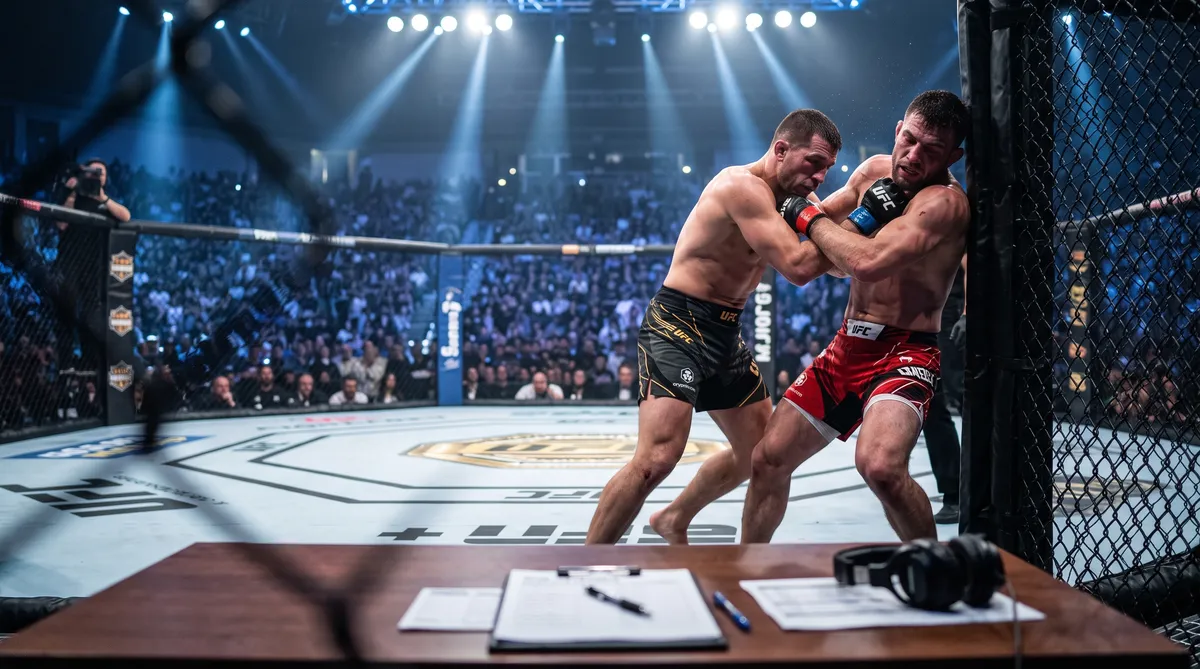
How MMA Judges Tally Championship Rounds: A Matter of Damage and Control
How MMA Judges Score Championship Rounds: Damage, Control and the Myths of a Title Fight
Commentators will tell you a thousand times over that one must take the belt from the champion. But if you look at a judge’s scorecard cageside, there is no column for the titleholder. It is in the chasm between that kind of broadcast lore and the reality of the Unified Rules of MMA where many a fighter has been found wanting in a round he was sure was in the bank.
Rounds four and five are won by a strict scoring hierarchy, not by sentiment. To see how a title fight is put on paper, one needs to understand what judges place value on when it comes to takedowns, fatigue and impact.
01. There is No Champion’s Advantage in the Late Rounds
Round by Round Isolation
A judge starts every round at 10-10 and from there applies the criteria. The Unified Rules of MMA preclude them from factoring in momentum or the status of the champion for the current five minutes. What happens in round four is scored on its own merits.
FIGHTER TAKEAWAY: Do not expect a defending champion to be given extra credit in the fifth. Judges view each round in total isolation; treat it like a sudden-death affair.
The adage that you have to “clearly beat the champ” is a cliché for the telecast, not something the NSAC or CSAC enforces. In fact, this notion can be tactically costly. A challenger who plays it conservative in the fifth, thinking he needs a knockout to secure the decision, is simply ceding a round to the champion that could have been his with some clean volume.
02. Impact is King in the Cage
Tier One Dominance
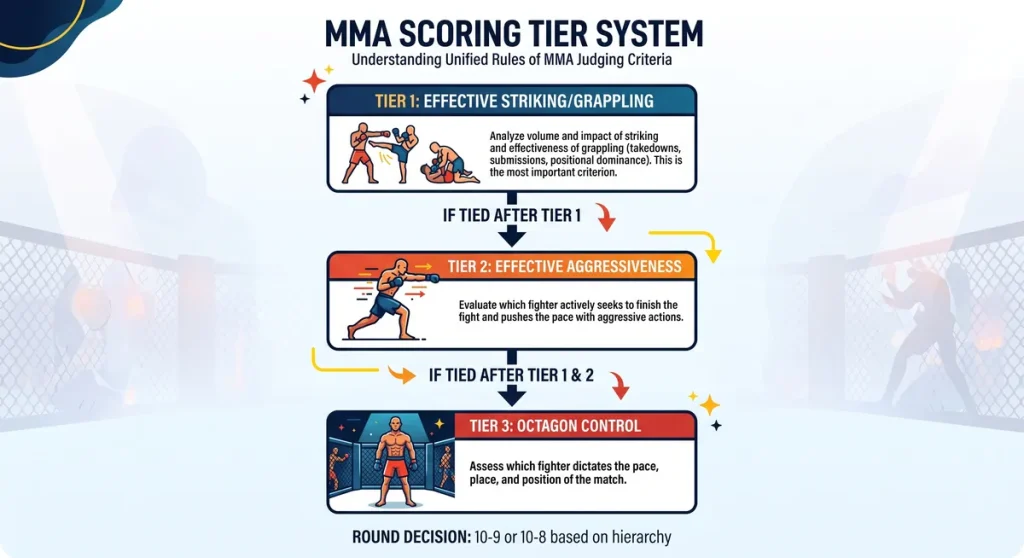
The rules put effective striking and grappling at the top of the tier system. By effective striking we mean legal blows that stun an opponent or alter his output. For grappling, it is the takedowns and ground strikes that present a genuine threat, not just occupying space.
If the metrics are to be believed, volume is no match for heavy damage. An opponent may land eight punches, one of which makes your knees buckle, and still win the round over a man who has thrown sixty jabs of little consequence. Judges are told to consider the quality and the result of a strike, not the raw number.
Then you have octagon control and aggression. These are second and third tier considerations that only matter if the striking and grappling have been judged completely even for the duration of the round. Most casual observers miss this entirely, but a fighter can hold the center of the cage all night and lose the round if the other guy has landed the more telling shots.
03. The Grappling Dilemma: Time vs. Damage
Takedowns Without Punishment
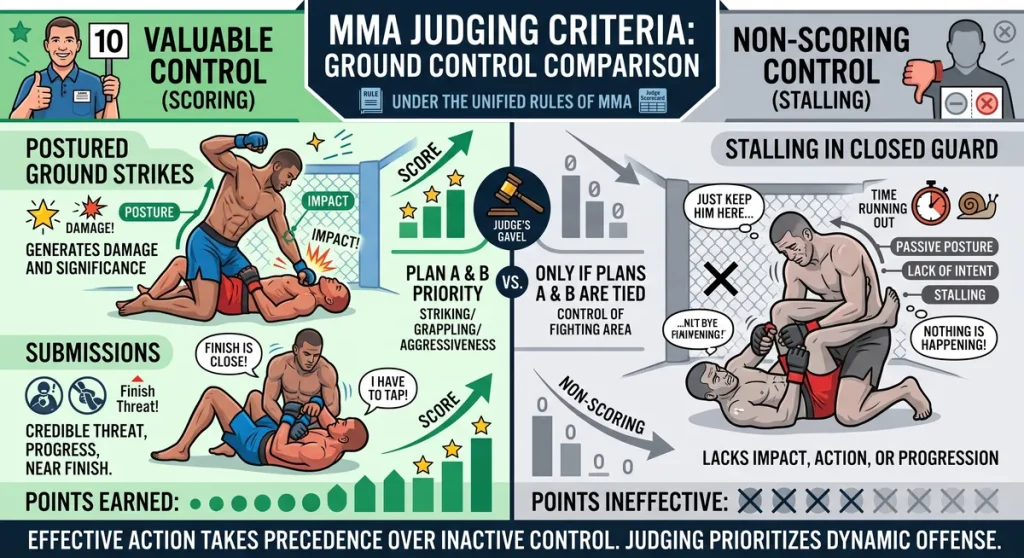
The old way of doing things, the lay and pray method of putting a man on the mat and holding him there until the bell, has been rendered obsolete. Under the modern Unified Rules, a takedown is only worth anything if it is accompanied by an attacking threat or immediate damage.
WATCH OUT: Pinning an opponent on the ground or against the fence without throwing a strike or going for a submission will not put points on the card. If you are stalling on top and he gets two elbows in from the bottom, he has the round.
Even if you are taken down and get back to your feet, the striker will have the judge’s favor if he put in the harder work earlier in the exchange. When a judge is applying Tier One criteria as he should, there is no contest: active submission threats and postured ground and pound will trump passive top control on any given scorecard. You may hear the color commentator or the live crowd in the arena say otherwise, but a fighter who puts an opponent down with thirty seconds to go and then does nothing more than hold position is not going to be credited with that round.
04. The 10-8 Threshold When Fatigue Sets In
Cumulative Damage in Deep Water
To get a 10-8 from a judge you need three things in concert: damage, dominance and duration. It is not something handed out for one big moment unless it was a near finish. Under the Association of Boxing Commissions and Combative Sports expanded scoring rules, judges are inclined to mark down a 10-8 for a fighter who has been dominant and is racking up damage over the course of the frame. This happens with greater frequency in the fourth and fifth rounds as a man’s defensive reflexes dull with tiredness.
The championship rounds see their share of 10-8s for that reason. Glycogen is gone, the strikes have taken their toll and fighters are slower to check a kick or slip a punch and get out of trouble. A competitor who was all but even after three can turn a scorecard on its head with a fifth round of heavy damage and control. Fading late is punished severely on paper as well as in the cage, a pattern easy to confirm by cross-referencing significant strike totals on UFC Stats.
MMA Scoring Tier System at a Glance
| Tier | Criteria | When It Applies |
| Tier 1 | Effective striking and grappling | Always the first consideration |
| Tier 2 | Effective aggressiveness | If Tier 1 is a dead even |
| Tier 3 | Fighting area (octagon) control | Only when Tiers 1 and 2 are even |
Conclusion
There is no mythical champion’s cushion to be had in the championship rounds. To win them one must make an impact that is visible and hard to argue with, rather than looking for shortcuts in control time. Should the matter be left to the judges in round five, damage will always win out over stalling provided the Unified Rules of MMA are followed.
Of course, judging is done by humans under less than ideal viewing conditions cageside, so reasonable men may come to different conclusions on a close round. But none of this supersedes the athletic commission’s final word on a bout.
FAQ Section
Are standard and championship rounds scored differently?
No. The same Unified Rules of MMA apply to rounds four and five as they do the first three. What changes is the physical toll on the fighters; the fatigue makes the disparity in damage much more apparent to the judges.
Can a late takedown steal a round?
Not under the modern Unified Rules. Judges credit a takedown for the threat or damage it engenders. If a fighter secures top position with half a minute left and does not strike or work for a sub, it will not cancel out the striking damage from earlier.
What is the number one thing judges look for?
Effective striking and grappling. That is the primary tier. They will only move on to secondary considerations like aggression or octagon control if they find the effective output to be completely equal.
Does the challenger have to put the champion away to take a decision?
Officially, no. Each round begins at 0-0 and is to be scored in isolation. Judges are told not to factor in who is wearing the belt.
What separates a 10-8 from a close round?
It is the combination of damage, dominance and duration. A short flurry is not enough. The judge wants to see sustained control and real damage for the better part of the five minutes.
- Momentum and champion status do not carry over; every round is a 10-10 to start.
- Octagon control and aggression are only relevant if the primary tier of effective striking and grappling is tied.
- Modern scorecards offer little reward for lay and pray tactics absent of strikes or submission attempts.
- A 10-8 is not for a single highlight but for a round of accumulated damage and dominance.
- Physically fading in the later rounds is a double punishment. Fatigue magnifies the damage you take and that shows up on the scorecard.

Author’s Note
Enjoyed this breakdown? Hit the subscribe button to get our latest documentary drops and fight camp analysis sent straight to your inbox before they go public.
Support Independent MediaAPEX STRIKE GEAR
Official Training & Equipment Partner of EOF. Elite gear for elite performance.
Explore Gear →