


Rigid Cups or Foam Guards: A Look at Combat Sports Chest Protection and the Rules
Chest Protection in Combat Sports: Rigid Cups vs Compression Guards and Commission Rules
The point of protective gear is to be a solution, not another problem. Put a chest guard on any fighter that has a habit of riding up in the middle of a round or digging into a rib on a body shot and he will tell you the wrong equipment can be more of a nuisance than none at all.
01. The Armor Dilemma
Torso protection must hold up to knees, kicks and direct punches in live sparring but still allow for free rotation and hard breathing through a full arc of a punch. If it does not do both, it is quickly put aside regardless of the claims on the label.
More often than not, fighters do not complain about a lack of protection from their chest guard. They complain that restrictive gear robs them of lung capacity at the worst possible time, like in the third round when every breath is already being rationed.
02. Rigid Plastic Inserts vs High-Density Foam
There is a mechanical difference between the two. Rigid plastic cups are meant to deflect impact away from soft tissue, putting a hard shell between the force and the ribs or sternum. Good against one heavy shot, but the rigidity can lead to edge bite.
If the cup is a size too big or moves with a torso twist, the bottom rim will not sit flush. That hard edge then becomes a lever, focusing the power of a body punch into a narrow line on the floating ribs.
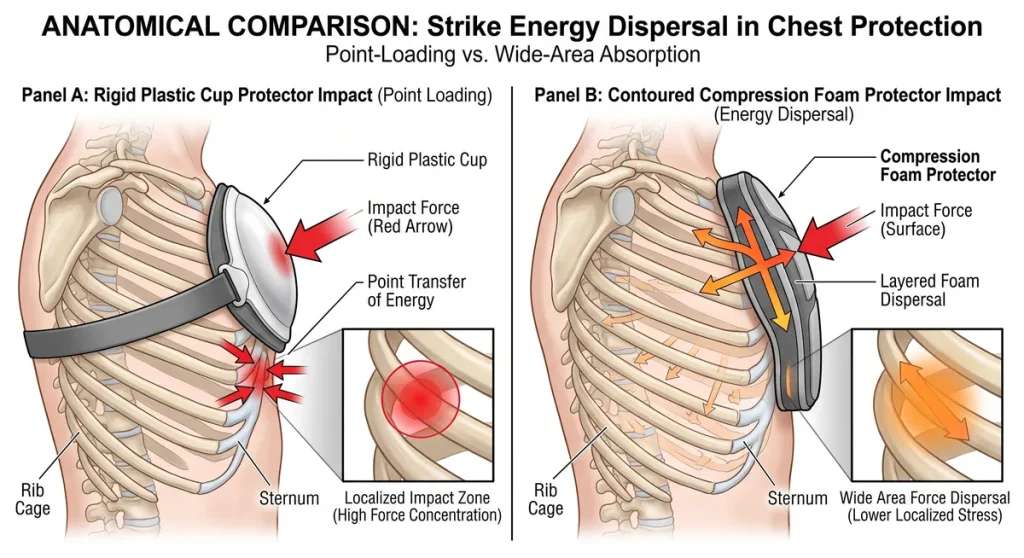
High-density EVA foam and multilayer compression tops handle things in another way. The foam gives way to the force and spreads it over a contoured surface that flexes in time with the body. You may give up some deflection on the heaviest of strikes, but you eliminate the risk of edge bite and the gear will not fight you when you need to breathe and turn.
WATCH OUT: Do not step into the ring with a rigid plastic cup that goes past the bottom of your rib cage. Absorb a body punch while slipping and that hard plastic will act as a lever, driving the impact right into your floating ribs for a painful cartilage bruise.
03. What the Commission Rulebooks Say
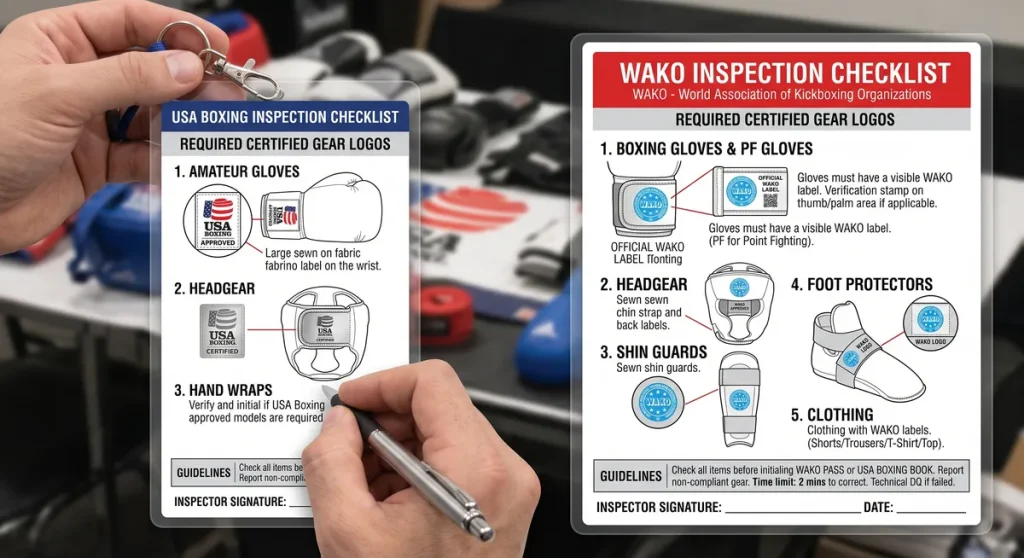
Do not assume an organization’s requirements are universal; it is the easiest way to get turned away at gear inspection. USA Boxing, for instance, lists breast and pubic protectors as optional for women in its official competition rules.
Some are more stringent. Under the amateur female rules of the Association of Boxing Commissions, properly fitted breast and groin protectors are a requirement for female boxers. At the pro level, the ABC’s guidelines make an abdominal guard and foul proof cup non-negotiable, but leave breast protectors to the boxer’s choice. One does not need to assume a single rule holds for the entire sport; in fact, that very inconsistency is what makes it important to look at the sanctioning body and division in question. An item of gear might clear inspection with one amateur federation only to be turned away at another’s weigh-in.
04. Protecting Ribs and Unlocking the Diaphragm: The Perfect Fit
The first order of business in sizing is to remove any gap zones but avoid binding the lats or armpits. A chest guard may do its job in shielding the sternum, yet if it pinches under the arm when throwing a full rotation punch, it will be left on the bench after a week of training.
Most fit issues can be nipped in the bud with a functional check. At rest, a fighter ought to be able to take a deep breath and slide two fingers under the band or straps without difficulty. That kind of mobility needs to be there even as the shoulders go through a complete hook or cross.
FIGHTER TAKEAWAY: Put your chest guard through a deep inhalation test before parting with your money. Should the cup or band put the brakes on rib expansion at rest, expect to be short of oxygen by the time round one is done.
Then there is the matter of foam breakdown, which is as much a safety concern as comfort. New compression foam is designed to disperse force, but once it has been flattened by repeated impact and no longer recovers its shape, the guard is simply not as protective as it was off the shelf.
FAQ Section
Is chest protection a must for women in boxing and kickboxing?
It depends on the rules of the division and the sanctioning body. You will find some amateur groups that require certified protection for female competitors. USA Boxing, for instance, considers breast protectors optional in their competition rules. As professional regulations are set by state or national athletic commissions, it is best to verify with the body overseeing the event.
What is behind the rib pain from hard plastic guards?
If a rigid cup is a touch too big or moves about, the bottom edge will bear down on the sternum or lower ribs on contact. Rather than spreading the energy of the strike, the hard plastic focuses it into one spot.
Rigid plastic or foam compression?
Foam has the edge in terms of contouring, shoulder freedom and breathability. But for deflection against a heavy shot to the sternum, a rigid insert is hard to beat and is called for in certain amateur tournament rule books.
How snug should it be?
Snug enough on the rib cage to not get in the way of a full breath. There should be room for two fingers under the straps while you rotate your shoulders through a punching arc.
- A rigid plastic cup is good at deflecting a heavy strike but can suffer from “edge bite” if an oversized rim shifts and drives force into the floating ribs.
- For a fighter who values endurance, high-density compression foam is the wiser choice; it gives up a measure of peak deflection to ensure full mobility and less chance of injury from gear that has moved out of place.
- Do not overlook the rulebook before fight week. Some organizations make chest protection compulsory for women while others do not, so knowing the difference between sanctioning bodies is key.
- Periodic replacement of gear is a safety imperative, not a luxury. Over time, the foam will break down from impact and quietly offer less protection.
- A simple two-finger test with a full inhalation will reveal any sizing flaws that would otherwise sap a fighter’s capacity in the later rounds.

Author’s Note
Enjoyed this breakdown? Hit the subscribe button to get our latest documentary drops and fight camp analysis sent straight to your inbox before they go public.
Support Independent MediaAPEX STRIKE GEAR
Official Training & Equipment Partner of EOF. Elite gear for elite performance.
Explore Gear →