

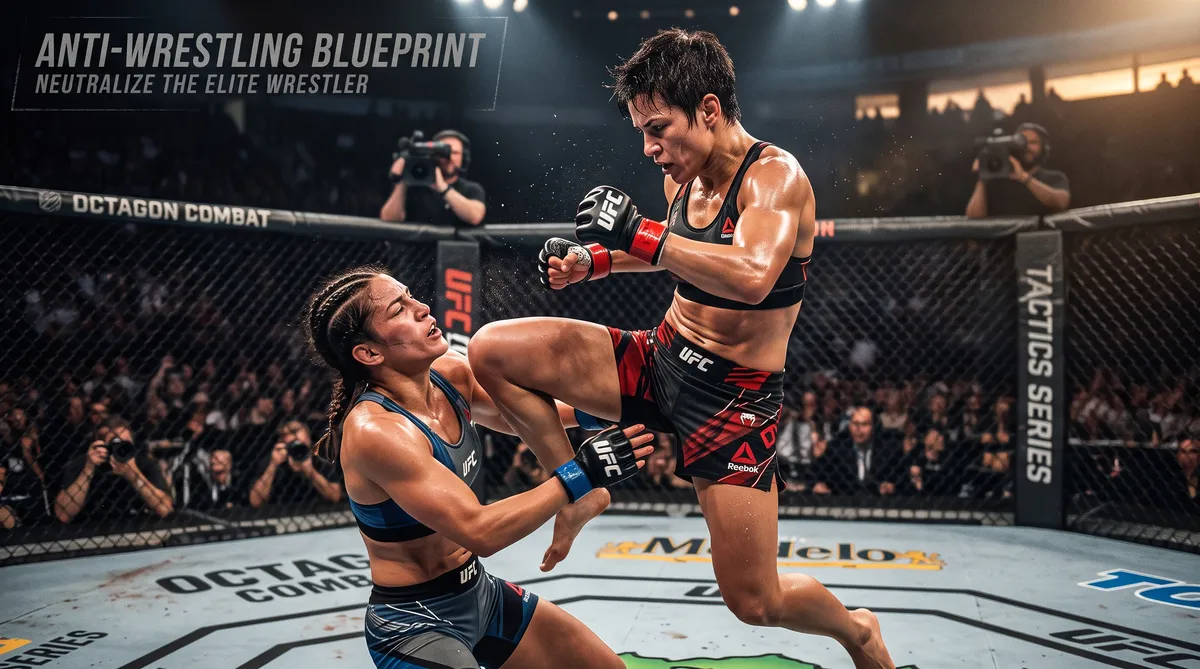
The Anti-Wrestling Blueprint: How Strikers Put an End to Elite Wrestlers in the Octagon
How Strikers Neutralize Elite Wrestlers in the Octagon: The Anti-Wrestling Blueprint
Before a single punch is thrown, the striker has already made his biggest error if he is fighting with trepidation and freezing up for fear of the takedown. You do not need an Olympic caliber sprawl to best an elite wrestler; it comes down to making every level change costly and punishing entries that are predictable.
01. Stance and Center of Gravity: Lowering the Target
Why the Upright Kickboxing Guard is a liability
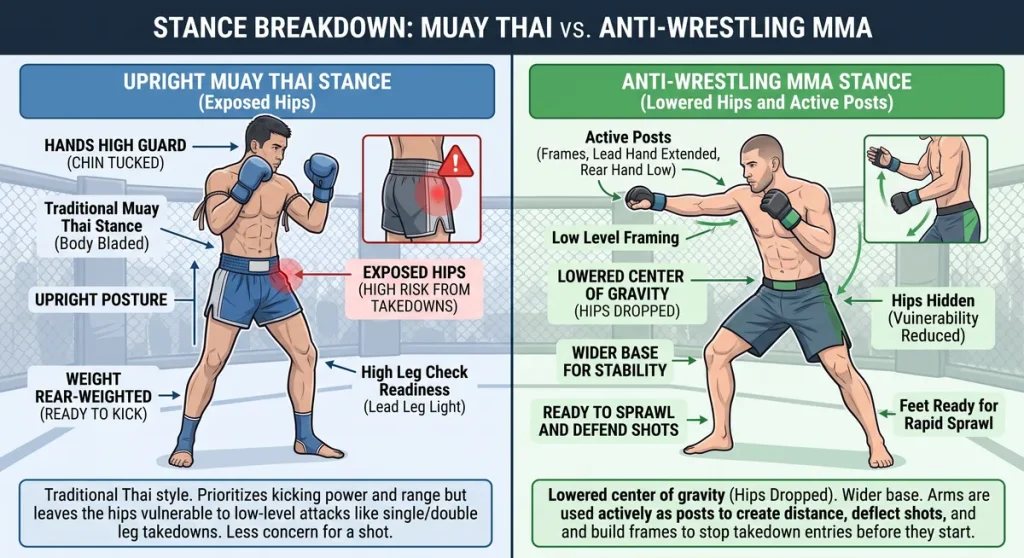
A tall, square stance may be fine for striking on angles, but it is handing the wrestler what he is after. With hips stacked right over the feet, the hip line is open to a blast double leg which is a hip capture in all but name. If you watch closely, you will see the takedown is underway the second a striker’s posture offers a clean angle under his center of mass, long before the shot itself.
Those dealing with top tier wrestling threats will have dropped their hips and put some width in their base, shifting weight back on the rear leg while remaining ready to strike. It seems like a tradeoff to shorten the distance to your hips, but in doing so you rob the wrestler of the momentum he would otherwise build. A frame or sprawl is more effective when there is less force to redirect.
Hand placement is no less important than the hips. The lead hand should be held a bit lower than a conventional guard to intercept an underhook in the first fraction of a second of an entry. By the time the wrestler’s shoulder is under the armpit, it is too late to react if he has any pedigree at all. And keep the weight distribution near fifty-fifty. Put too much into a jab or low kick and the base is compromised on contact, giving the wrestler the opening he needs to finish the job.
02. Ring Geometry and Footwork: Don’t Back into the Fence
Controlling the Center Octagon
The most fatal technical flaw for a stand-up fighter is a straight-line retreat under pressure. Every step backward puts the center of gravity in the path of the wrestler’s forward drive, building the head of steam required for a double leg.
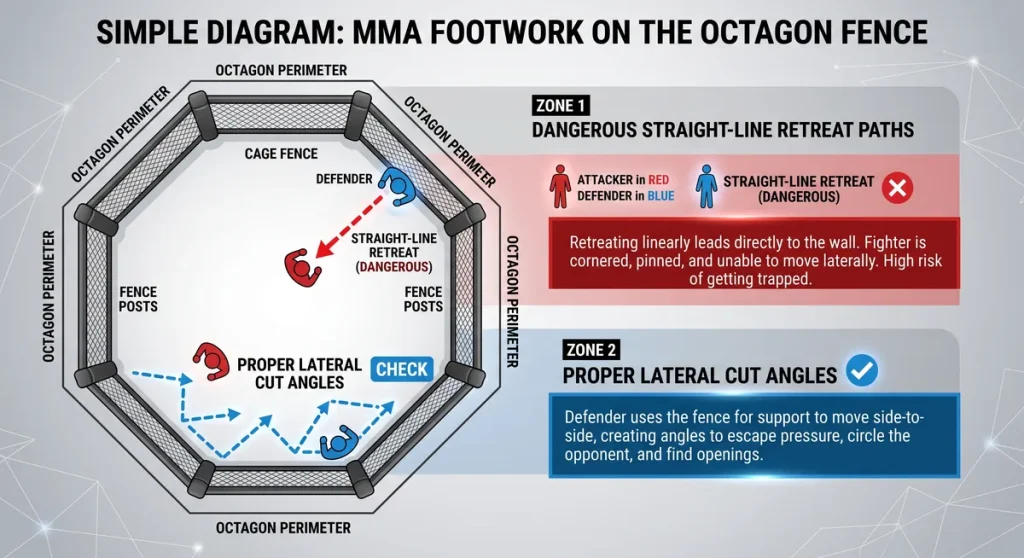
Superior footwork is about sharp lateral cuts and pivoting off the centerline well before the back is to the cage. This forces a reset of the wrestler’s hips and rhythm, allowing the striker to set the range.
FIGHTER TAKEAWAY: Do not give a pressuring wrestler a straight line to drive through. Cut a lateral angle to make him pivot and re-set his hips.
There is value in a hard feint or false level change from the shoulder to draw a premature shot from outside the pocket. When facing a chain wrestler of the Khabib or Makhachev variety, a solitary reactive sprawl will not suffice once he turns a stuffed double into a single leg drive along the fence. Anti-wrestling is a sequence of denials, not a single move. Jose Aldo understood this hip discipline, using a pivot to turn away Chad Mendes and others before they could get their hands on him. UFC Stats put Aldo’s takedown defense at 92 per cent for the span of his WEC and UFC tenures, a figure among the best ever for someone without formal wrestling credentials. It was an impressive stat to have on the books before his 2017 unification fight. But the pivot he employs is more than a defensive reflex; it is an offensive means of putting the striking distance back in his favor.
03. Weapon Selection: The High-Reward and the High-Risk
Firing Down the Centerline
Generic advice on striking does not always account for the different risks one faces from a wrestler. A wide hook or an undecorated roundhouse kick will cross the body instead of the centerline and create an opening for a level change as soon as the strike is made. An elite wrestler has no trouble catching a leg on a kick that was not set up by a punch, running the pipe into a takedown while the striker is left with open hips and only one leg to stand on.
WATCH OUT: There is no easier way to surrender a takedown than to throw long kicks with no boxing to back them up. Make the mistake of throwing a roundhouse to the body without a combo to hide it and an elite wrestler will have you flat on your back in short order.
You can sidestep that with strikes down the centerline. A stiff jab, an intercepting knee off a collar tie or a short uppercut will all meet the head momentum of a wrestler without the kind of hip compromise a long kick entails. The lead hand is useful for both framing and measuring range, making early contact on the forehead or collarbone to break the wrestler’s forward posture.
Then there is the matter of the intercepting knee. Most amateur strikers in the gym do not have the balance discipline for it. If a knee is thrown with the full weight of the hip committed forward as if against a heavy bag, the fighter is overextended and at the mercy of a wrestler who ducks under. The right way to stop a shoot is to keep the weight centered and use the knee as a sharp interruption rather than a power blow, accepting less impact to ensure one stays upright even if the timing is a fraction off.
04. The Scramble and Frame: Dealing with Contact
Underhooks, Head Position, and Getting Out
All the footwork and centerline work in the world will not prevent every entry. Once a wrestler has closed the gap and put hands on the hips, the nature of the fight changes from one of striking to position. Too many strikers try to put in some work inside the clinch before they have addressed that positional issue.
It is better to contest for an underhook in those first moments than to land a strike. Having one on either side provides the leverage to turn a wrestler away from the fence and deny him the double collar tie that leads to most finishes. And if one can win the battle for the head under the opponent’s chin, it breaks their posture and robs them of the downward pressure needed to walk a striker to the cage.
Once the position is neutralized, the rule of separation should be observed. Do not attempt any real offense until the hips are clear of the clinch; trying to strike while still tied up costs the balance required to defend what comes next. You can see this in the way Israel Adesanya framed up against Derek Brunson, creating space and holding back on the early offense to deny Brunson the control time his background would normally allow. The sport’s rulebook is also a factor here. Under the Unified Rules of MMA as the Association of Boxing Commissions have them, how a round is scored by judges will reflect on fence and clinch control. A clean disengagement is as much protection on the scorecards as it is positionally.
The Bottom Line
Strikers who play defense let the wrestler win. There is an art to the striker’s victory: it comes from controlling the distance and making aggressive entries costly. When a striker has the discipline for his hips, lateral movement and centerline weapons, he presents a wrestler with nothing but a wall of sharp edges. The unease that builds over the course of five rounds in such an exchange is more telling than any one sprawl could be.
FAQ
Is there too much risk in kicking an elite MMA wrestler?
In many cases, yes. A high kick or an unguarded roundhouse to the body leaves the striker on one leg for a fraction of a second. An elite wrestler will not let that go; he will catch the kick or time a level change for a takedown. Setups are therefore all the more important when facing a grappler as opposed to a pure striker.
Which stance holds up best against a wrestler?
You want something lower and wider, with the hips back to lower the center of gravity. The tall, upright way one might stand in traditional Muay Thai is a liability here, as it puts the hips at the mercy of a well timed double leg.
How can a striker avoid being caged in by the Octagon fence?
By keeping the feet moving laterally and pivoting off the centerline before one’s back is to the cage. If you do end up on the fence, inside frames and head position under the chin become the priority. Dig in for an underhook to put some space between you and the wrestler and get back to the middle of the Octagon.
What kind of strikes put a stop to a wrestling shoot?
Things like a stiff lead jab, an uppercut or a collar tie knee. They come down the middle and meet the head of the wrestler without giving away hip position as a wide hook or long kick would.
Where do strikers most often go wrong?
Retreating in a straight line under pressure is a costly habit. It places your center of gravity right in the path of the wrestler’s momentum, which is precisely what he needs to make a double leg work.
- A fifty-fifty weighted stance that is held low denies the wrestler the room he needs to capture and affords the striker extra time to deal with an underhook.
- Lateral cuts to the angle will break forward momentum where a straight retreat cannot, compelling the opponent to reset his hips.
- Jabs and uppercuts are ideal for meeting a wrestler on entry since they don’t open the hip lane in the manner of a long kick.
- Do not rely on a reactive sprawl; a chain wrestler will move from a double to a single leg along the fence. Anti-wrestling must be a sequence.
- When contact is made, securing underhooks and head position takes precedence over offense until the clinch is broken and the hips are free.

Author’s Note
Enjoyed this breakdown? Hit the subscribe button to get our latest documentary drops and fight camp analysis sent straight to your inbox before they go public.
Support Independent MediaAPEX STRIKE GEAR
Official Training & Equipment Partner of EOF. Elite gear for elite performance.
Explore Gear →