


Warning Signs of Overtraining in Combat Sports: What Every Fighter Needs to Know
Overtraining in Combat Sports: How to Recognize Burnout Before It Does You In
There is a certain culture in the gym that lauds the fighter who never puts in a missed round. The downside is it makes for athletes who arrive at fight week with their hands a little slow and their decision making clouded, bodies that have been done with adapting for some time. The signs of overtraining in this sport do not tend to be loud. They manifest as minor breakdowns that most will dismiss as part of the normal grind of camp.
01. The Grindhouse Trap
An eight week camp is about outworking the other guy, but there is no linear relationship between the number of rounds and what you put on display on fight night. Training stress is only useful if you have the recovery to take it.
The difference between being productively fatigued and suffering a systemic collapse is whether the body has had its window to supercompensate before the next hard session. A fighter who layers hard sparring over unresolved fatigue is not in better shape; he is racking up a debt that will come due in the middle of a bout.
You see this trap ensnare the disciplined type more than the lazy one. For the athlete who considers every scheduled round non negotiable, putting in the work is a matter of principle. To him, skipping a round is a moral failing, so he will power through the early warnings rather than make a sensible call based on his recovery status.
02. Neurological Red Flags
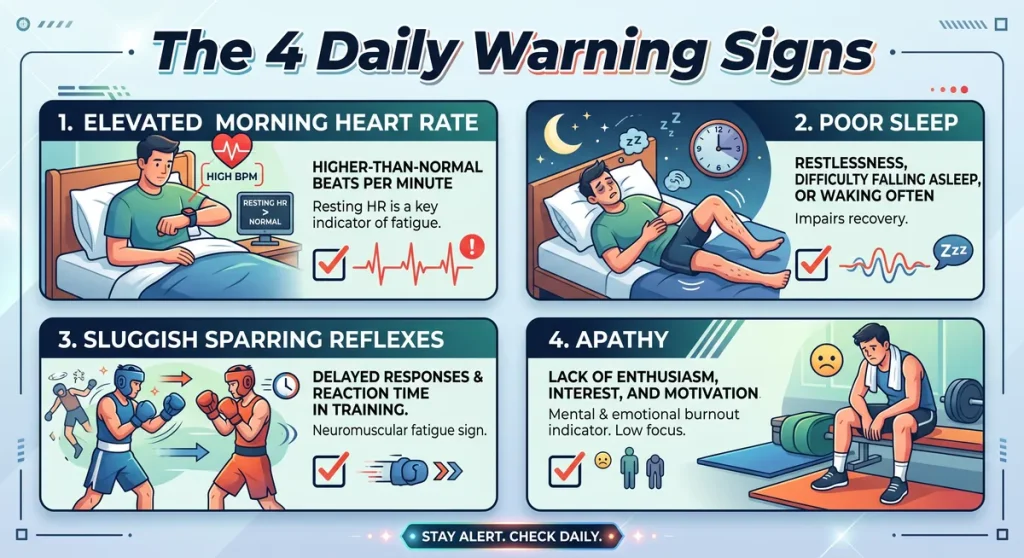
Soreness is not the first or most perilous indicator of overtraining. Watch for the fighter who is suddenly taking shots he would have seen from three feet away in any other circumstance.
Central nervous system fatigue will dull the processing speed required for reaction timing and peripheral tracking, regardless of how good the cardiovascular system feels. One can put in a perfect gas test on the bike and still get clipped in sparring because the nervous system has no more capacity for fast twitch responses, even if the lungs are fine.
WATCH OUT: When your timing in sparring goes and you are getting hit by things you normally slip without thinking, the nervous system is done for the day. Hard sparring in the face of such burnout is a sure way to raise your risk of a concussion.
03. Insomnia and Heart Rate
Being physically wrecked and yet wired at 3 a.m. is no scheduling error. Studies on sleep architecture in athletes point to an overactive sympathetic nervous system as the culprit, creating a state of arousal that prevents restorative sleep.
Your morning resting heart rate should be taken as an alarm. If the pulse is running several beats higher than your usual camp baseline, it is a sign of excessive catecholamine release and a nervous system that has not settled into recovery during the night.
04. The Hidden Symptoms of Mood and Immune Drop
A coach might write off a general apathy for training or a slow healing skin infection as bad luck. But recurring colds and a lack of interest in the sport are systemic warnings.
The European College of Sport Science and American College of Sports Medicine would call it prolonged maladaptation across hormonal and neurochemical regulation, not a failure of one system in isolation. There is a practical side to how one frames these issues. When a fighter is dealing with chronic joint pain, a flat mood and some recurring minor ailments all at once, that is a systemic pattern on display. It is not simply three separate bad weeks in a row.
Yet you will find coaches who are content to monitor the visible numbers, sparring output, pad power, and they miss it completely. The stopwatch and the scale do not tell you much about a fighter’s immune system or his mood. A brief daily check in to see how he is really feeling, as opposed to what he is putting out, will reveal a downturn long before it becomes a missed weight cut or a lackluster showing on fight night.
05. The Camp Recovery Blueprint: How to Course Correct Fast
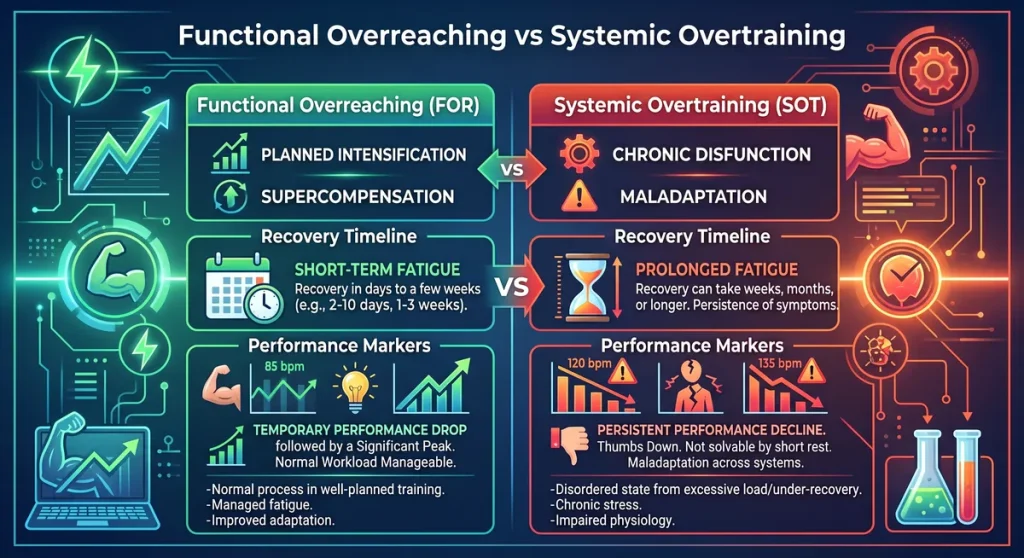
The consensus statement makes a point of distinction that fighters would do well to understand. Functional overreaching is something that can be put right in a matter of days with lighter work. True overtraining syndrome is another story; it can take weeks or months to put behind you, which is why it is better to spot the early indicators than to have to deal with them in an advanced state.
FIGHTER TAKEAWAY Overtraining is no excuse to put in two weeks on the couch. Halve your high intensity sparring for four days, let the technical drilling be light and put in more sleep at night to reset the nervous system.
A tactical deload of four days does the job without having to walk away from camp four weeks before a scheduled bout. Trade the live sparring for technical flow and hard conditioning for Zone 2 nasal breathing cardio, and be deliberate about your carbohydrate intake. In combat sports, the signs of overtraining are not a weakness. They are the body’s most dependable way of telling you the training load has run ahead of recovery.
FAQ Section
What are the first warning signs?
You will see them in a sudden loss of reaction time in the spar, or in irritability that is uncharacteristic of the fighter. There may be lingering aches in the joints, an elevated heart rate in the morning and an inability to get to sleep even when physically spent. These things tend to present themselves together.
How does overreaching differ from overtraining?
According to the ECSS and ACSM, functional overreaching is a temporary fatigue you plan for in camp and that goes away after a few easy days. True overtraining is a deep crash of the hormonal and neurological systems that is not so easily resolved.
Why is sleep elusive for an overtrained fighter?
The body is being kept in a heightened state of arousal by the sympathetic nervous system thanks to chronically high levels of cortisol and adrenaline from physical overload. That blocks off the kind of restorative sleep required for recovery.
Is there a way to correct course in the middle of a fight camp?
Put in place a three to five day deload. Do away with the heavy circuits and hard sparring and in their stead do some technical work, Zone 2 cardio and make sure to get extra sleep and carbs.
Does it make a fighter more injury prone in sparring?
It certainly can. Central nervous system fatigue will slow down a fighter’s reflexes and tracking regardless of his cardiovascular shape. He may feel fit enough but his reactions will be lagging in a live exchange, which is a recipe for a concussion or other injury.
- When a fighter is getting hit by shots he should be seeing and his sparring reflexes are slow, that is often the most perilous sign of overtraining, even if he feels aerobically sound.
- An elevated resting heart rate in the morning and insomnia are clear evidence of a nervous system in sympathetic overdrive instead of recovering overnight.
- The joint ECSS and ACSM statement is clear: overtraining is a prolonged maladaptation of several biological systems, not an isolated issue.
- While functional overreaching is over in days, true overtraining can last for months, so recognizing it early is worth far more than trying to treat it later.
- A four day deload of technical drilling and Zone 2 cardio is enough to give the nervous system a reset while keeping the camp on track.

Author’s Note
Enjoyed this breakdown? Hit the subscribe button to get our latest documentary drops and fight camp analysis sent straight to your inbox before they go public.
Support Independent MediaAPEX STRIKE GEAR
Official Training & Equipment Partner of EOF. Elite gear for elite performance.
Explore Gear →