

MMA Cornering Strategy: The 60-Second Edge Elite Coaches Use to Win Fights
MMA Cornering Strategy: How Elite Coaches Win Fights in Sixty Seconds
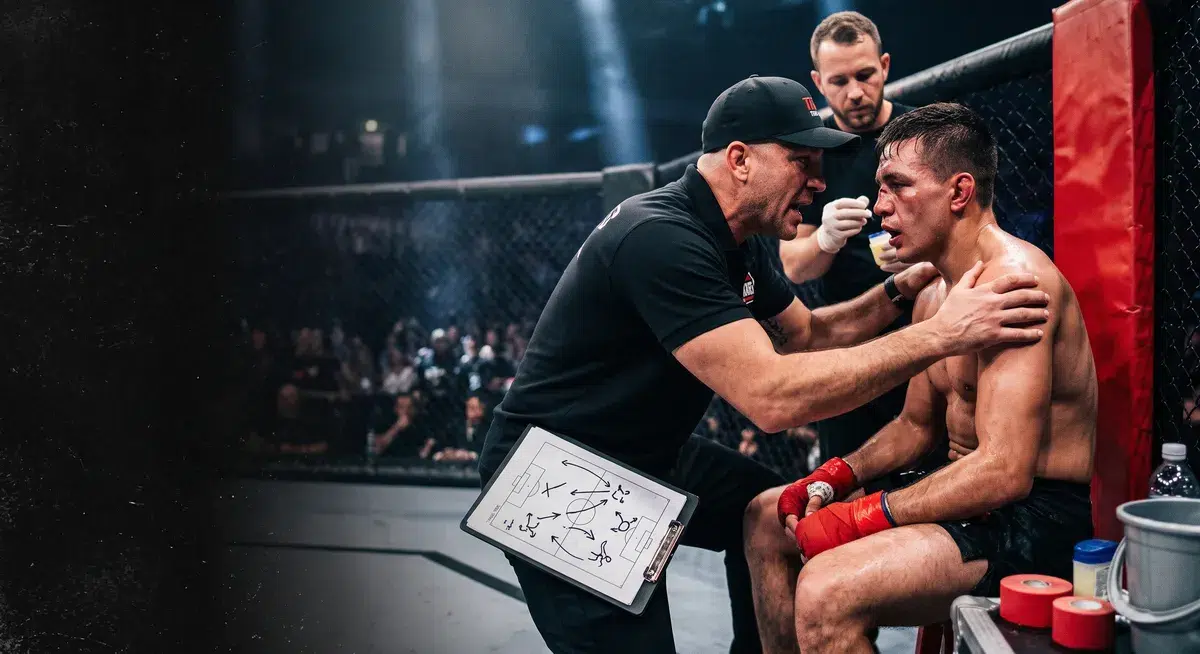
To call it two athletes in a cage is to miss the point. What you are watching is a chess match played out in real time by the corners on a sixty second clock. There is no room for cheerleading; it is about emotional control and issuing unambiguous orders to a man whose heart is hammering at 180 bpm and whose capacity for language is beginning to fail.
The ABC’s Unified Rules of MMA allow for five minute professional rounds separated by a one minute respite. That minute is perhaps the highest leverage in any sport. A corner can decide the outcome of a fight in that time before the bell has even sounded again.
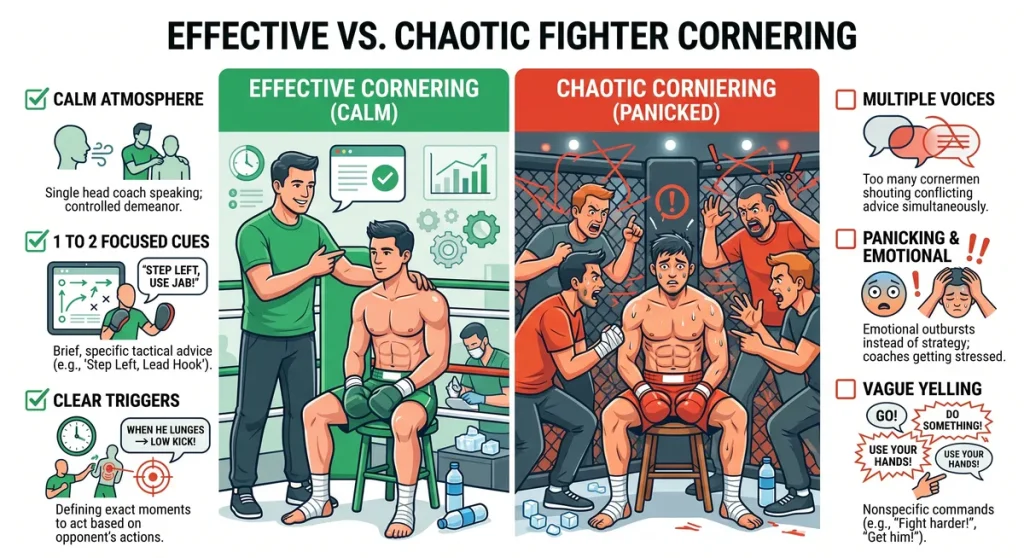
01. The One Voice Rule: Putting an End to Chaos
A fighter who has just come off the stool after five minutes of work is not thinking clearly. Adrenaline has put him in a state of auditory exclusion and tunnel vision. He is physically incapable of taking in more than a couple of simple directives.
Amateur corners make the mistake of letting the head coach, manager and training partner all shout their pieces over the din of the crowd. The fighter’s brain cannot distinguish priority from noise and ends up with nothing. Elite camps are strict about delegation to avoid this:
- The head coach is the only one to offer technical instruction.
- The cutman is left to his work with the enswell and swelling in silence.
- The second is occupied with the mouthpiece and water.
There is no point in wasting seconds with hollow exhortations to “wake up.” Every moment not devoted to hard information is ceded to the opposition.
02. The Clock Breakdown: What Happens in the 60 Seconds
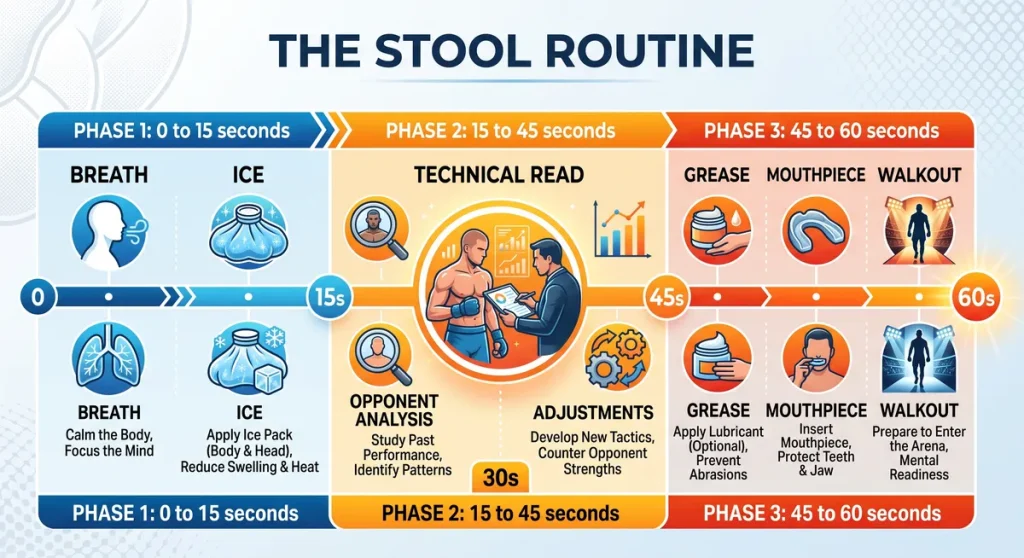
Top corners do not use the minute for a pep talk. They have a system.
The first 15 seconds are for the body, not the game plan. You will see the airway cleared and ice put to the neck while the enswell is applied. There is no use in laying out tactics to someone who is still gasping for breath.
From 15 to 45 seconds, once the heaving of the chest has subsided, the head coach will give a concrete read, “slip right after the jab” or “circle his power hand.” In the final 15 seconds, the loop is closed with some Vaseline and a parting mental cue so the fighter goes back out with one idea, not five.
FIGHTER TAKEAWAY: Do not expect a man on the stool to follow a five step combination while three voices are yelling at him. An elite coach gives a clear trigger and lets the athlete handle it.
03. Mid-Fight Diagnostics: The Winning Adjustment
You can tell a championship corner by its ability to spot patterns when the pressure is on. Where the audience sees a round being won, an elite coach is noting the drop guards and feints, the small leaks that appear over the course of five minutes.
Consider the distinction between a command and a trigger. To order a fighter to “throw the overhand” is to make him deliberate on the timing in the heat of the exchange. A trigger is conditional: “he steps heavy, you drop for the double.” It is a tripwire for reaction, not a task.
Trevor Wittman, who has worked with Kamaru Usman and Justin Gaethje, is often pointed to as an example of this surgical simplicity in the corner, eschewing the need for complicated mid-fight overhauls. One has to say the method has been under a microscope. Take Usman’s 2022 knockout at the hands of Leon Edwards in UFC 278; there was plenty of commentary from the likes of Teddy Atlas to make one wonder if an over-reliance on striking in that last round was a factor. It is a case in point for how even the best corners have to make tactical trade-offs and no read is without risk.
04. The Ultimate Responsibility: A Shield Against the Fighter’s Own Instincts
When to call it quits
A corner does not exist solely to put a win on the record. There are times when winning ceases to be the objective. While the referee is the only official with the power to end a bout, a corner can still signal a stoppage or retire its fighter between rounds. Ego must be put aside for that call.
The indicators are never vague. You will see them in a broken orbital bone, the concussive look in a fighter’s eyes, or a complete lack of output while taking unanswered shots. If the fighter is no longer in a position to defend himself with any intelligence, the obligation is to safeguard his health for the long term rather than worry about a line on a resume.
WATCH OUT: Pride has no place in protecting your fighter. If an athlete is being pummeled and cannot follow what you are saying on the stool, the coach’s first duty is to save him for another day.
Conclusion
You will find championships are made on the stool in the sixty seconds before the next horn, by way of trust and clarity, not volume. An effective MMA cornerman isn’t going to try and put in new techniques in the middle of a fight. The strategy is to hand the fighter the one key he needs to get through the round in front of him, nothing more.
FAQ
What is the cardinal rule of cornering?
The one voice rule. Let the head coach be the one to give technical direction while the cutman and secondary corner tend to the physical side of things, the icing, hydration and so on, in silence. When a fighter is running on adrenaline and fatigue, having multiple voices shout at once is just sensory overload.
How should those 60 seconds between rounds be spent?
The first 15 are for the fighter to catch his breath and for the corner to deal with swelling and clear the airway. In the middle 30 the head coach will make one or two technical adjustments. Then in the final 15 you apply the grease, put in the mouthpiece and offer a parting mental cue.
What if the fighter is getting outclassed?
Stay calm and direct. There is no use in panicking or wasting precious time with broad complaints like “wake up.” Be honest and give an instruction you can act on, like telling him exactly which counter or level change will break the opponent’s momentum.
When is it time to throw in the towel?
When there is structural or vision damage, or the fighter is absorbing strikes with no answer and no chance to put anything back. Under the Unified Rules of MMA the referee is the sole authority to officially end a contest, but a corner can and should retire its fighter. Protecting the athlete’s future is always more important than pride or a single outcome.

Author’s Note
Enjoyed this breakdown? Hit the subscribe button to get our latest documentary drops and fight camp analysis sent straight to your inbox before they go public.
Support Independent MediaAPEX STRIKE GEAR
Official Training & Equipment Partner of EOF. Elite gear for elite performance.
Explore Gear →