


Strength and Conditioning for Grapplers: Build True Mat Power
Strength and Conditioning for Grapplers: How to Put Together Real Mat Power and Not Burn Out
There is no point in benching 300 if you are going to be ragdolled in the opening minutes of an open mat roll. Grappling requires a particular type of strength: isometric tension under duress, the ability to drive your hips explosively from a bad spot and the kind of rotational endurance to see you through a string of scrambles. Your time in the gym should be in service of what you do on the mats, not something that undermines it.
01. Gym Power is Not Mat Strength
The problem with a bodybuilding split for a combat athlete is that it isolates muscles. In a guard pass, there is no such thing as a single muscle working on its own; the load is shifting across the forearms, hips, spinal erectors and grip all at once. An opponent who has trained his force output as one unit will have no trouble stacking and sweeping a fighter with a bigger bench but less integrated total-body power.
Then there is the matter of fatigue. A five-day split will have your shoulders and legs too sore for an evening of sparring, and sore muscles lack the timing and integrity a live roll calls for. You chase a pump in the weight room and you have less to give when it comes to the work that builds technique. For an athlete putting in four to six days on the mats, a few high yield compound movements will do more for recovery than any amount of isolation work.
02. Three Pillars You Cannot Do Without
Hip Extension, Isometrics and Rotational Armor
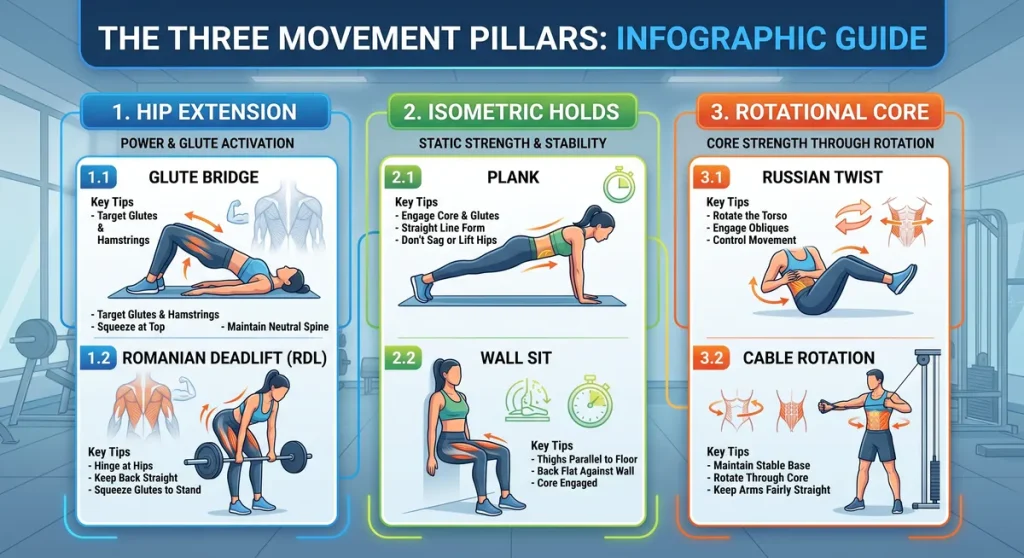
Pillar 1 is hip extension. Whether you are bridging from the bottom or a wrestler is sprawling, it all comes down to the posterior chain. Trap bar deadlifts, hip thrusts and kettlebell swings put you in the same pattern.
Pillar 2 is the isometric hold. When you are in closed guard or trying to keep side control on a guy who is scrambling, it is a battle of seconds and minutes, not a single rep. You will find Zercher carries, sandbag holds and towel pull-ups build a crushing power you cannot get from standard lifting.
Pillar 3 is multi-planar core. A sit-up is straight flexion; passing guard and twisting for a submission loads the spine in rotation. Landmine rotations and Pallof presses put up resistance to the forces an opponent brings to bear.
And do not overlook the hands. The National Strength and Conditioning Association has put together research showing that judokas and wrestlers have a need for grip endurance that most programs ignore.
FIGHTER TAKEAWAY: Functional strength in this sport is often found in stillness. Put in some heavy carries and thick grip hangs and you will have the sustained power to put an opponent in his place from top mount or closed guard.
03. Aerobic Base First: Conditioning for the Scramble
Most people think grappling cardio is all about sprint work because that is where matches are decided. But you have to fix the gas tank first. The demands of the sport make it plain that a fighter’s bursts of action are bookended by long stretches of grip fighting and positional control. To recover in between, one needs aerobic capacity; sprint speed will not do the job.
Consider the grappler with a poor aerobic base: by the third minute he is in a stalled position and cannot bring his heart rate down. That tactical pause becomes fatigue for the next scramble. The remedy is to put in the steady work in the lower training zones to build a foundation, then add interval repeats that reflect the true work to rest ratio of a live round. You end up with a gas tank that fits how grappling is done, as opposed to the way a distance runner might train.
There is a flaw in some of the more casual conditioning advice out there. Endless jogging may put an aerobic floor under you but does nothing for the nervous system when a scramble calls for something explosive and unpredictable. These two elements have to be trained in concert.
04. A Blueprint for 2-Day and 3-Day Weekly Scheduling
Structuring Weights Around Hard Sparring Days
For the competitive grappler the programming rule is straightforward: do not max out on heavy lifts right before an open mat session of high intensity. If a fighter has put in the hours on a heavy deadlift set, he is going to be on the mats with slower reactions and a compromised grip at the very time he can least afford it.
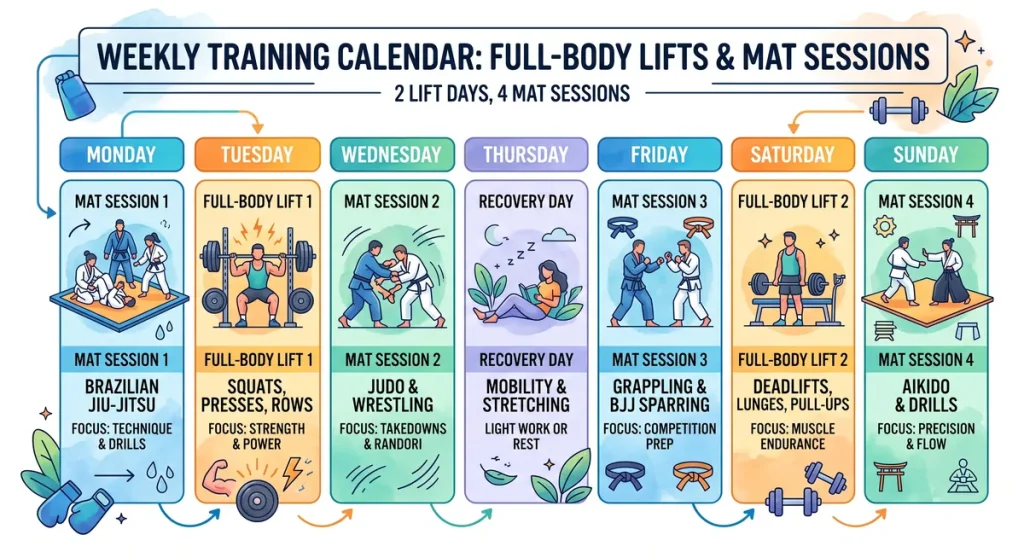
A full body split over two days, timed to be as far removed from the week’s toughest sparring as possible, will handle the three movement pillars without the kind of wear and tear a five-day split brings. Three sessions is fine for those doing fewer live rounds, but the principle holds: the lifting is there to support the mat work, not get in its way.
WATCH OUT: In fight camp, never take a lift to muscular failure. It is a sure way to fry your central nervous system and invite joint trouble in live sparring while dulling your reflexes.
Building the Engine That Actually Matters
When it comes to strength and conditioning, we look for durability and efficiency rather than what is being moved on the bar. Focus on the three movement pillars and keep some reps in reserve; let your technique on the mats remain the priority.
Frequently Asked Questions
How often should a grappler be in the weight room?
Two or three days is the mark to aim for. Anything beyond that tends to produce systemic fatigue which gets in the way of learning new techniques and recovering from sparring.
Will heavy weights leave you stiff or slow in BJJ?
Not if you are doing full range of motion resistance training properly. That builds tendon resilience and stability. Any stiffness is usually down to poor mobility or a lack of recovery, not the lifting.
What about cardio?
You want a solid aerobic base and some high intensity intervals. Jogging is good for a foundation, but grappling is about the rapid recovery after an explosive burst of control.
Is it wise to train to failure?
No. Leave a rep or two in the tank on your strength sets. Pushing to failure only raises the risk of injury when you are rolling live.
- A big bench press does not mean much on the mats because grappling is about total-body force transfer, not isolated hypertrophy.
- What is non-negotiable are the three pillars: hip extension power, multi-planar core stability and the ability to hold an isometric position.
- Since matches are won on recovery capacity and not raw speed, the aerobic base is paramount.
- Schedule two or three full body sessions well clear of hard sparring to cover your bases and protect the central nervous system.

Author’s Note
Enjoyed this breakdown? Hit the subscribe button to get our latest documentary drops and fight camp analysis sent straight to your inbox before they go public.
Support Independent MediaAPEX STRIKE GEAR
Official Training & Equipment Partner of EOF. Elite gear for elite performance.
Explore Gear →