


Zone 2 Cardio for Combat Sports: Put an Elite Gas Tank on Your Fighter
Zone 2 Cardio for Combat Sports: Build an Elite Gas Tank Without the Burnout
It does not matter how clean the submissions are or how sharp the striking if the fighter gasses out first; he will lose. And there is no building endurance by putting in redline high-intensity intervals at every session. That only builds fatigue, which is not the same as being fit.
There is a hidden engine to championship-level stamina and it is forged with the slower pace of Zone 2. You see it in the biological system at work when a Max Holloway type imposes a suffocating pace well into the championship rounds. Once you understand that, it changes the way a fighter should be programming his week.
01. The Sparring Myth: Why Redlining Every Session is Bad for Your Gas Tank
The Aerobic Floor vs. Anaerobic Ceiling
Walk into many fight gyms and the practice is to make every session a five-round war. There is hard bag work, sprints, tire flips, all of it feels productive because it leaves you exhausted. But the body is unable to distinguish a tough sparring round from a conditioning circuit in terms of the cortisol response and the toll on limited recovery reserves. Exhaustion is not a sign of adaptation.
When the pace picks up in a real fight, fighters find that anaerobic training has given them a ceiling but no floor. The fast glycolytic pathway that powers a takedown or an explosive strike has little endurance; it will fire hard and be empty in a minute or two of sustained output. It remains so until the aerobic system comes in to clear the byproducts of that exertion.
Amateur programs often overlook this. They put more and more height on the explosive ceiling while the aerobic floor is left alone. The result is a fighter who looks devastating in round one and is up against the wall in the third, not for lack of power but because he never built the system to refill the tank.
FIGHTER TAKEAWAY: If during a Zone 2 session you can not get a full sentence out or have to open your mouth to breathe, you are overdoing it. Letting the heart rate drift too high is just adding to the fatigue for no reason.
02. The 60-Second Reset: Clearing Fatigue Toxins with an Aerobic Base
Cardiac Output and Muscle Capillaries in Plain English
Do steady-state cardio at a truly low intensity and you train the heart wall to thicken and stretch. Over time it can put out more oxygenated blood with each beat without having to quicken its pace. A bigger stroke volume means the heart is not working as hard to move the same amount of blood, and you will see that in a lower resting and working rate over a training block.
The numbers from elite MMA athletes bear this out. A PMC study on conditioning in mixed martial artists showed that after a proper block, the heart rate at the second ventilatory threshold (the true aerobic ceiling) went from 153.8 to 164.0 bpm. At the same time, the intensity a fighter could hold at that threshold jumped from 77.3 to 86.9 per cent of max. In short, the fighter can now put in much more work before the anaerobic zone starts to drain him.
You see similar figures in the UFC Performance Institute’s analysis of its roster, with male fighters clocking a VO2max of 58 to 66 ml/kg/min. That is well above the norm for the athletic population and is the product of consistent low-intensity work, not just sprints.
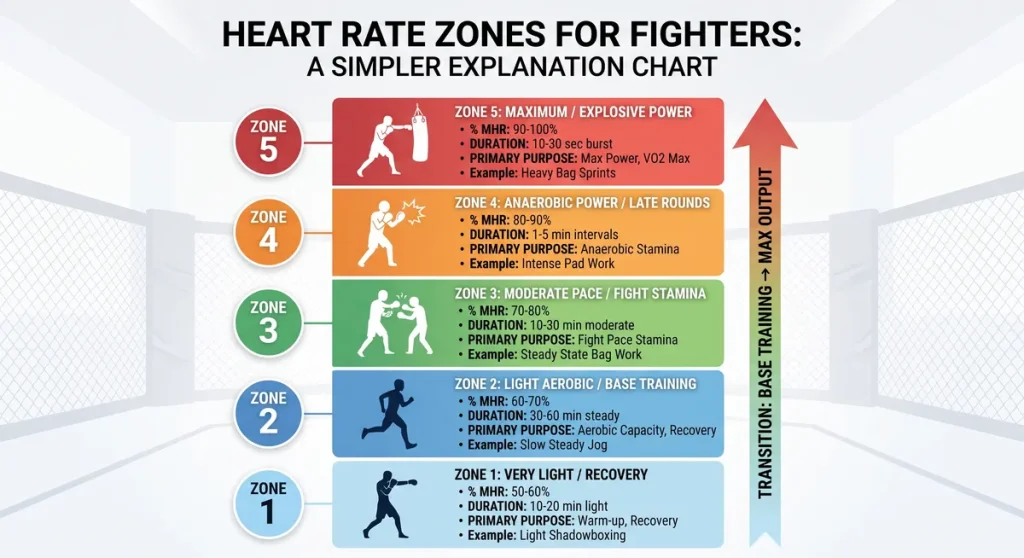
None of this is abstract when you are in the corner for the 60-second break. A good aerobic base is what clears the lactic acid and tops off cellular energy in that window. It brings the heart rate down quicker so you can step back in for round two fully reset and not running on fumes.
DID YOU KNOW?
The anaerobic system gives you the knockout flurries and the takedowns, but the aerobic system is what puts the fuel back in the tank. Without a solid aerobic foundation, a fighter will see their explosive reserves run out in the space of two minutes with no way to make them up.
03. Joint-Saving Machines: The Best Low-Impact Options for Fighters
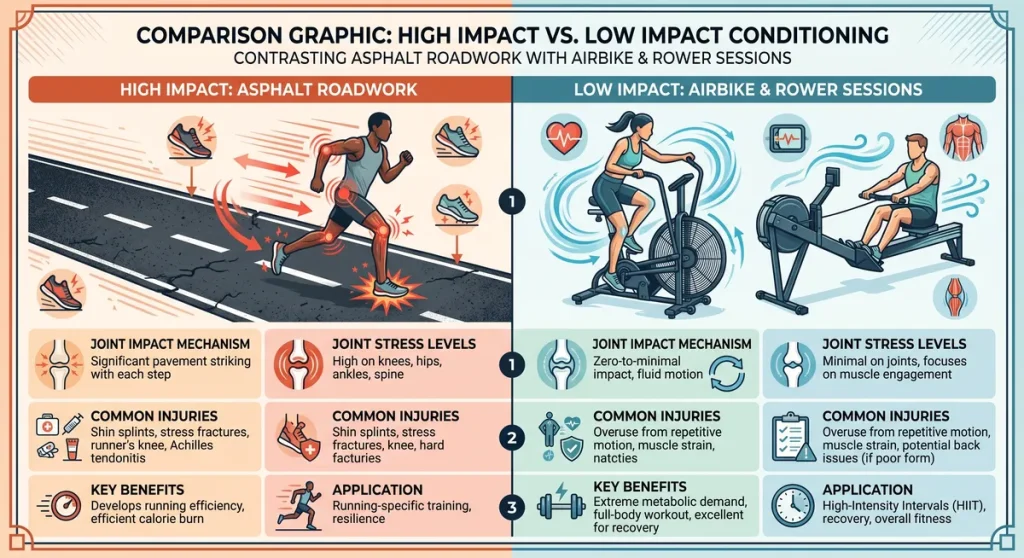
There is an old-school boxing adage that has heavyweights putting in five miles of road work every day. But all that asphalt pounding puts repetitive stress on joints that have already taken their share from takedowns and hard landings on the mats. You can see the tactical cost of it; a fighter who chases his aerobic base purely by mileage will often report to camp with a lower back or knees that are too sore to put in the kind of hard sparring required.
Low-impact machines offer the same aerobic gains at a far lower orthopedic price. With an AirBike or Concept2 rower one can drive real Zone 2 output through the legs and upper body at once, free of ground impact. An incline on the treadmill will get the heart rate where it needs to be without the pounding, while some well-controlled shadowboxing at a Zone 2 pace serves as both conditioning and technical work.
Coaches sometimes miss the point in making the switch to these modalities. It is not a matter of comfort. A fighter with sound joints in the final weeks of camp can take more hard sparring rounds, and that is where the fight-specific skills are honed. Preserving the joints during your aerobic work is what leaves you with the training budget for the important stuff.
04. Programming Your Weekly Camp: A Blueprint for Zone 2 Cardio
Zone 2 has its place in a camp but it should not come at the expense of recovery for the sessions that develop skill.
- Two or three days a week, 40 to 60 minutes each, on days you are not doing hard sparring or heavy grappling so as not to compound fatigue.
- Easy days must be kept easy. If a Zone 2 session bleeds into Zone 3 it is counterproductive, putting unnecessary strain on the central nervous system for no real aerobic benefit.
- Be mindful of the days bracketing a hard sparring session. Doing Zone 2 right after can aid recovery with increased blood flow, but scheduling it the day before runs the risk of leaving enough leg fatigue to blunt one’s explosiveness.
The Bottom Line
Champions are made in the fire of hard sparring, to be sure, but they are powered by the quiet, steady aerobic engine put in place behind the scenes. Zone 2 cardio for combat sports is how to build that engine without wrecking the nervous system or joints a fighter will need on fight night.
FAQ
What does Zone 2 look like for a combat athlete?
In terms of heart rate, we are looking at 60 to 70 percent of maximum. A good field test is the talk test: the fighter should be sweating but able to hold a conversation entirely through the nose without any gasping.
Is there a risk of becoming slow or weak?
Not if done properly. Two to three times a week is sufficient to improve power endurance and refill those explosive energy stores between exchanges without taking away from the strength and speed put in at the weight room.
Which exercises are best for MMA or BJJ?
Stick to the low-impact side of things. The air bike, ski erg, light swimming or an incline walk on the treadmill will develop capacity without the orthopedic toll on the hips and ankles that the mats exact.
How does this help in the break between rounds?
That 60 seconds is when the aerobic system is at work clearing lactic acid and topping off cellular energy. A strong base built on Zone 2 means the heart rate comes down quicker, so the fighter is closer to being fully reset for the next round.
- Anaerobic power with no aerobic floor is a dead end. Those explosive strikes will be gone in a flash and stay that way until the aerobic system does its job.
- Research on elite MMA talent indicates the second ventilatory threshold can be pushed higher, allowing for greater output before the tank is drained.
- UFC Performance Institute figures show the average male athlete’s VO2max running 58 to 66 ml/kg/min, a mark well above the norm and the result of consistent low-intensity work.
- Whether it is the rower or an incline treadmill, these tools provide the adaptation of road work without the joint stress.
- A couple of genuine Zone 2 sessions a week, timed right and kept easy, will do the job without any compromise to power or recovery.

Author’s Note
Enjoyed this breakdown? Hit the subscribe button to get our latest documentary drops and fight camp analysis sent straight to your inbox before they go public.
Support Independent MediaAPEX STRIKE GEAR
Official Training & Equipment Partner of EOF. Elite gear for elite performance.
Explore Gear →