

MMA Reach Advantage: The Way Wingspan Governs Striking Distance
How Reach Advantage Dictates Striking Distance in MMA
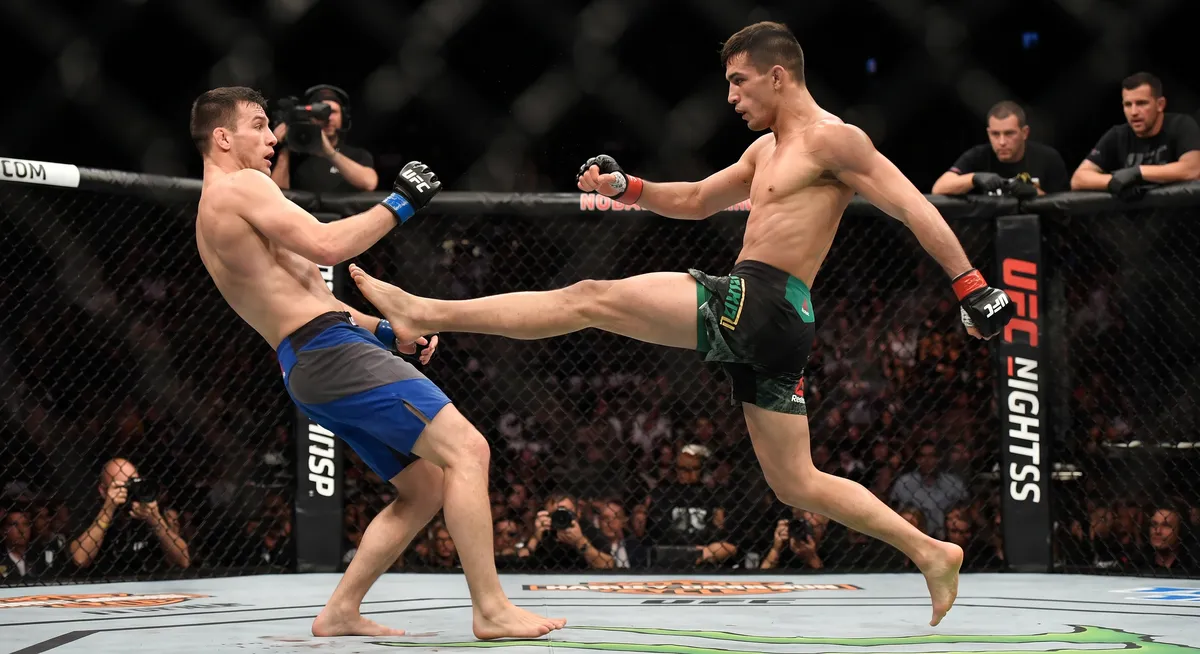
On paper, a tale of the tape tells you little about an actual fight. But put three inches of extra arm length in the cage and it might as well be a brick wall between you and your opponent. Reach is the arbiter of the danger zone; the longer fighter gets to call when the combat is on and the shorter has to put up or shut up every time they try to get in.
To the uninitiated, reach is just a number on a graphic. In reality it is an active tool to be enforced, and one that can be undone with the right footwork. Knowing how this control of distance is exercised is the difference in how a fan watches a bout and how a fighter prepares for it.
01. The Illusion of Range: Why Wingspan Defines the Danger Zone
The Physical Math of Striking Range
There is a line where a fighter can land without having to step forward first. That is maximum effective reach. For the man with the longer arms, that line is further from his chest than it is for his counterpart, allowing him to touch a target that is out of the other’s grasp.
It is an uneven equation. Take Jon Jones, whose 84.5 inch reach was the official UFC Stats number for much of his light heavyweight tenure. Put him against a 72 inch reacher and that opponent must put in twelve extra inches of travel to bring his own strike to bear. That is twelve inches of time for Jones to see the entry and react.
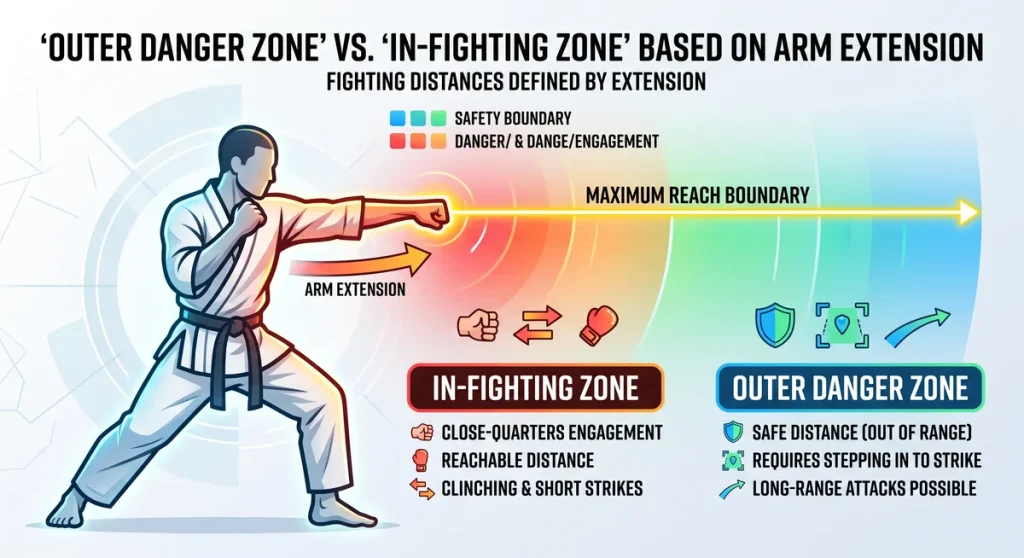
What you do not see on a casual broadcast is that the gap is not set in stone. It will expand or contract with a fighter’s posture and stance width, or how much weight he puts into a jab. A tall fighter who keeps his lead hand out is pushing the danger zone away; one who lets his posture go gives back some of that edge.
For the shorter fighter the trade off is plain. To close in on a rangy type you have to walk through live fire and accept the risk.
FIGHTER TAKEAWAY: Do not let your feet get frozen or the advantage is forfeit. A long fighter who stands still will have his range taken by an aggressor happy to crash the distance.
02. Weapons of Length: How Elite Fighters Lock Down Distance
Hand Fighting, Posting, and Stiff Jabs
You have to defend the space your reach affords you. The elite do not rely on passive footwork but on hand fighting. Put your palm flat on an opponent’s glove or forehead and you have physically measured the gap while blinding him for a second.
Jon Jones made a career of this, with oblique and teep kicks to the hip and thigh and a lead hand that never stopped working to unsettle an opponent before he could plant his feet. It is a low grade contact that warns you when pressure is coming and breaks the other guy’s rhythm.
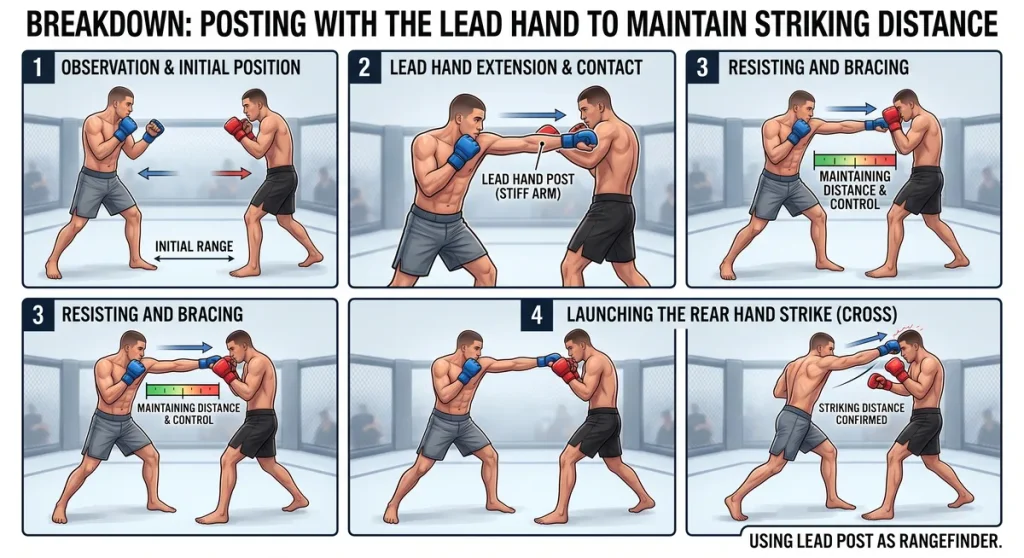
But hand fighting is a two way street. Lean too hard on your framing and you telegraph your moves; a sharp eye will time a level change under your arm. Then there is Sean O’Malley at bantamweight who does the same job of range control with a stiff jab and lateral movement rather than a static frame.
03. Cracking the Shield: How Shorter Fighters Break the Range
Head Movement, Feints, and Cutting Off the Cage
The surest way to be put out cold is to walk straight at a taller man. A linear path is the easiest thing to predict in this sport and the longer fighter will have no trouble timing a counter.
Feints are what separate those who get in safely from the ones who get countered. You draw out the long weapon before you need to. When a fighter employs a hard shoulder feint or a false level change, the longer opponent is put on the spot to react. That reaction might be a flinch or a check, or perhaps a jab that has been wasted; in any case it creates a half second of opportunity for the real entry to come in from an angle rather than head on down the center line.
There is a different kind of math at play when one cuts an angle off the center line as opposed to simply stepping forward, something Section 01 makes clear. A diagonal step does two things for the shorter fighter: it shortens the distance to be covered and puts him out of the way of where the longer man’s strikes are already going. Add in a level change to drop the head under the opponent’s extended arm and you have the makings of a phone booth fight, one where speed and volume trump arm length.
But there is a cost to this. A commitment to a diagonal cut or a level change leaves a fighter open for a fraction of a second. A longer fighter with good timing will not hesitate to put in a check hook or a knee to make the shorter man pay for it. One must understand that closing distance is a calculated risk, never a sure thing.
WATCH OUT: Do not make the mistake of backing up in a straight line against a taller man. A linear retreat robs you of your counter while leaving you right in his striking range.
04. Common Distance Errors That Cost Fighters the Fight
You will see even seasoned fighters make the same old mistakes when they misread their range with a longer opponent.
Take the fighter who leans back to throw a strike. By leaning away from the shot he is loading his weight on the back foot, making it impossible to put power behind it or get out of the way quickly. It also leaves his head on the center line for a follow up. Or consider the one standing at kicking range but failing to control the lead hand. He is sitting outside of punching range yet inside for teeps and leg kicks, allowing the longer fighter to work at will without having to commit to an exchange.
The Bottom Line
Reach may set the parameters of a contest but it does not do the fighting. Footwork, feints and timing are what determine who has the space. The fighter who sees an MMA reach advantage as an active battle to be won, and not some number on a stat sheet, will dictate where the fight is had no matter whose arms are longer.
FAQ Section
How is reach measured in combat sports?
In MMA it is full wingspan, fingertip to fingertip across the back with arms outstretched. Boxing can be a bit more ambiguous, often measuring arm length from armpit to closed fist, so be wary of cross-sport comparisons.
Is a win guaranteed with a longer reach?
Not at all. Christopher Kirk of Sport Science Review looked at 474 elite MMA competitors and found stature and wingspan to have little bearing on title bout success in most divisions. Reach is only an asset if the fighter can enforce it. Once a shorter man is past the outer guard, the leverage is gone and he is open to uppercuts and hooks.
How do you deal with a severe reach deficit?
Head movement, feints and cutting angles are the answer. Draw the long jab with a heavy feint and slip inside to work the body and head. Trying to make a straight line entry is the usual way this plan goes awry.
What is the ape index?
Also known as the stature to wingspan ratio, it is a measure of arm span in relation to height. A positive index means more striking room for the frame, but studies show it accounts for less than 1% of a fighter’s win percentage.
- A longer fighter’s reach establishes a danger zone that forces the shorter man to take on more risk with every entry.
- Do not mistake long arms for elite range control; that is an active skill born of hand fighting and low grade pressure.
- Linear footwork is the most expensive error a shorter fighter can make against a taller one, as it keeps him on the center line where he can be timed easily.
- Diagonal entries and feints are how the shorter fighter reclaims the fight at close quarters.
- And while raw measurements have their place, anthropometric research is clear: in the end, technique in managing distance is far more telling of an MMA win percentage than reach and wingspan alone.

Author’s Note
Enjoyed this breakdown? Hit the subscribe button to get our latest documentary drops and fight camp analysis sent straight to your inbox before they go public.
Support Independent MediaAPEX STRIKE GEAR
Official Training & Equipment Partner of EOF. Elite gear for elite performance.
Explore Gear →