

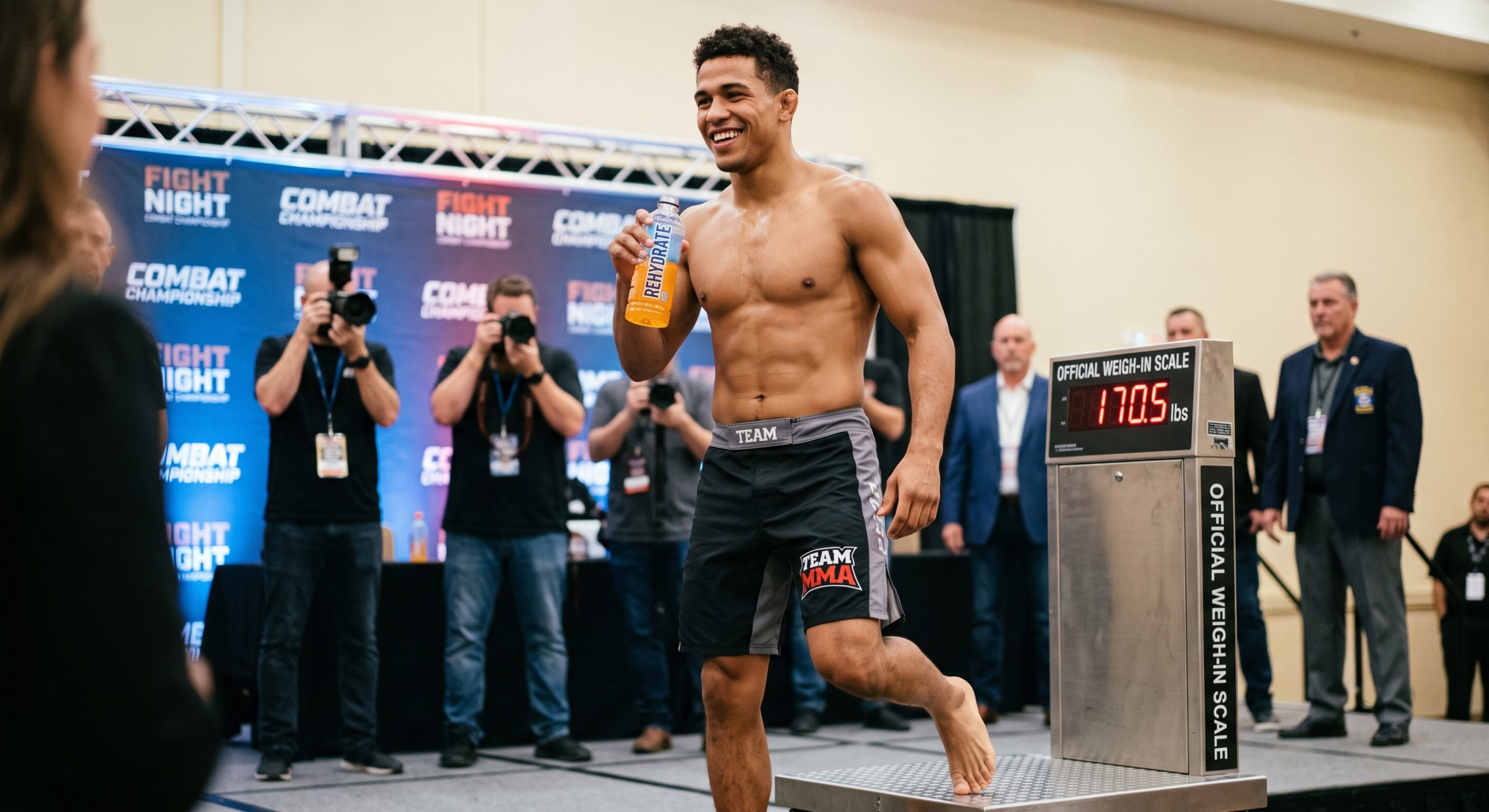
MMA Weight Cutting Safety Protocol: Making Weight and Preserving Fight Performance
MMA Weight Cutting Safety Protocol: How to Make Weight Without Killing Your Fight Performance
There is no honor in getting off the scale looking like a ghost. It is a tactical error that can cost a fighter before the opening bell. The whole point of making weight is water management; overdo it and you will have stripped away the chin, the gas tank and the power required to put an opponent away.
The objective is not to endure the scale but to be in the cage the following day with your reaction time and muscles in order and your brain well protected. A sound plan respects the biology of dehydration instead of being a contest to see who can last the longest in a sauna.
01. The Biological Cost: What Severe Dehydration Does
The Vanishing Cushion: Brain Trauma and Dehydration
Fans may not see it when a fighter is hauled off the scale, but the danger only builds toward fight night. The brain is meant to be cradled by cerebrospinal fluid within the skull. Dehydrate severely and you reduce that volume, giving the brain more opportunity to make hard contact with the skull upon impact.
You can see the results in the third round of a bout where a fighter’s chin seems to have vanished. It is not necessarily a lack of conditioning or a technical lapse; it is the physiological price of being under-cushioned. Then there is the matter of glycogen. Since muscles hold this energy in tandem with water, an aggressive cut will level those stores. No matter the work put in at camp, a fighter will find less explosiveness in his takedowns and strikes once the pace quickens in the second.
It is a harsh trade-off. You might gain a size and reach advantage by dropping down a class, but if the rehydration is not done right, that edge is gone by round two.
02. The Safe Zone: Limits Backed by Science
The 10% Rule and Commission Standards
Commissions have been clamping down on the numbers for good reason. The California State Athletic Commission made it part of their 2016 regulations to do a weight check on fight day; if a fighter is 10% over his contract limit he can be reassigned. By 2019 they were even more stringent, cancelling bouts if a fighter rehydrated to 15% above the weigh-in figure.
CSAC did not invent that rule out of thin air. Their review of 285 bouts in the first ten months of 2019 turned up 28 cases of fighters going past 15%, a much higher incidence than in boxing. The executive officer was quick to label it cheating, not smart management, and the Association of Boxing Commissions has used such state precedents in refining the Unified Rules of MMA.
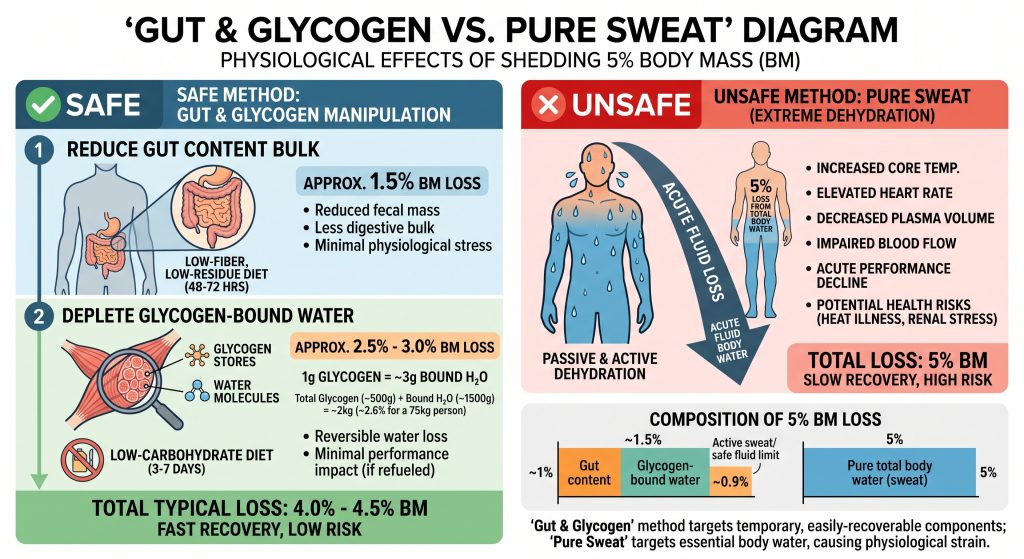
What one has to separate is the chronic dieting of the camp from the acute water cut of the final days. The Journal of the International Society of Sports Nutrition laid out the figures in a 2025 position stand: an acceptable loss is some 4.4% at 24 hours out, up to 6.7% at 72 hours. Any sweating via sauna or hot water should be capped at 2 to 4 percent of body mass in the last day under supervision. The rest of the weight should come from training and food long before the official scales are set up. An acute reduction in fight week is meant to address that last small fraction of weight, not to be a double digit ordeal squeezed into the final hours.
FIGHTER TAKEAWAY: There is a limit to what the body can take. Should water loss during fight week exceed 8% of your total body weight, the brain is left without its main cushion for protection. From there, each additional percentage point erodes chin durability no matter how well you have put in the work in training.
03. The Rehydration Window: 24 Hours to Put the Engine Back Together
Sodium, Carbohydrates and Fluid Balance
For the amateur, the fight is often lost in the two hours after leaving the scale rather than in the cage. Plain water is not enough to rehydrate a body that has been run down. In the absence of sodium to force osmosis and draw fluid into the muscle, water will just pool in the stomach, leaving the fighter bloated, cramping and feeling slower than the scale indicates.
The JISSN position stand is clear on what the numbers should be. You need an oral rehydration solution with 50 to 90 millimoles of sodium per deciliter, taken at a rate of about 1 to 1.5 liters an hour, then up to 60 grams of fast acting carbohydrates right behind it. For those who have done a hard glycogen depletion protocol, total post weigh-in carbohydrate consumption ought to be in the 8 to 12 gram per kilogram range to put back at least 10% of body mass before the bell rings.
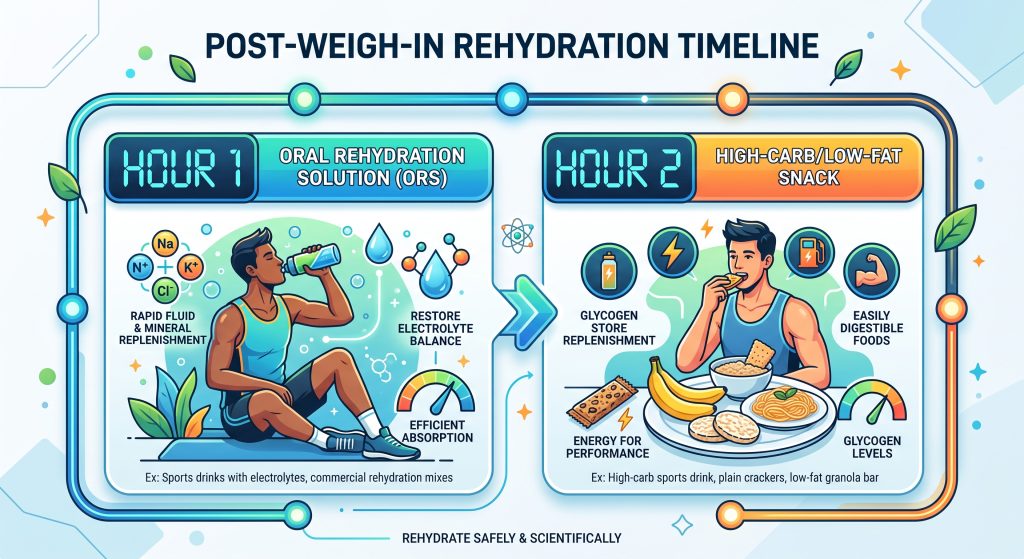
A good protocol puts sodium, simple carbs and fluid together in the opening two hours and moves to proper meals as the system settles.
- First 30 minutes: Take a high sodium oral rehydration solution in small sips, not all at once.
- Hour one: Add in some simple carbs to get the muscle glycogen resynthesis going while you keep drinking.
- Hour two: Have a full meal with complex carbohydrates and moderate protein, plus some electrolytes but little fiber to spare the gut.
- Hours three to twenty four: Keep a steady intake of fluid and sodium, gauging it by your weight.
There is no room for IV rehydration if you are under USADA’s purview, which includes everyone in the UFC. An infusion or injection over 100 milliliters in 12 hours is a chemical manipulation under WADA rules and will be viewed as an anti-doping violation unless you have an exemption. USADA is also quite blunt on the matter: IVs to fix mild dehydration are not clinically required when you can do it orally without the risk. So for top level fighters, the oral route is the only one on the table, and the JISSN figures provide the science to back it up.
WARNING: Do not make the mistake of chugging plain water after the weigh-in. Without the sodium and carbs to get that water into your cells, it stays in your stomach and you will be sluggish and cramping come fight night.
04. The 3 Weight Cut Errors That Empty Your Gas Tank
You can avoid most fight night failures with some basic planning; they usually stem from one of these three missteps in the week leading up to it.
- Letting the sauna go on too long. If you are still trying to shed a few percent in the hours before you step on the scale, you have given yourself no time to put some carbs in beforehand and you are already behind when rehydration begins.
- Drinking unsalted water after the scale. We have covered this, but large amounts of it will not make it to your muscles and in some instances can lead to hyponatremia.
- Not restoring your carbohydrates for fear of looking heavy on camera. Some fighters will forgo them after the weigh-in, but that leaves you with empty glycogen stores when you need to produce explosive power for three or five rounds.
The Bottom Line
If the scale is to be believed, it is only the first adversary of fight week. To come out on top on Saturday a fighter has to have some respect for what the human body can take on Friday. Those who view weight cutting as a matter of safety and performance rather than some kind of survival trial will step into the cage with an edge in reaction time, glycogen and brain cushion that a dehydrated rival has already surrendered.
FAQ Section
What is a safe amount of weight to put off in a fight week?
By and large, athletic commissions and experts consider an acute cut of 5 to 8 per cent of one’s total body weight to be manageable via water manipulation. But push past that with severe dehydration and you are inviting organ strain and compromised brain protection.
Can a fighter get an IV after the weigh-in?
Not if USADA has any say in the matter. They do not permit infusions of more than 100ml in a 12 hour window unless there is a therapeutic use exemption on file. The modern standard is to rehydrate orally with sodium and carbs.
How long is the road back to full rehydration?
To replenish glycogen and get the cells fully hydrated takes in the order of 24 to 36 hours. One can drink all the volume they like but without the proper sodium intake or by going at it too fast, the muscle tissue will not absorb it and the fighter will be flat when it matters.
Why does the process make a man easier to put on canvas?
It comes down to the cerebrospinal fluid that normally acts as a buffer for the brain within the skull. Deplete that and an impact carries more force against the bone. A shot that might have been taken is now a knockout.What is the CSAC’s role in monitoring this? The California State Athletic Commission has rules for a reason. Since 2019 they have had the authority to cancel a bout if a fighter is more than 15% over his weigh-in number on the day of the fight, having seen commission data on dozens of MMA bouts cross that line. They will also flag anyone who rehydrates to 10% above contract weight.
- There is no skill or conditioning that can offset the loss of chin durability when acute water cutting exceeds 8% of body weight and robs the brain of its fluid cushion.
- The JISSN position stand gives rehydration some hard numbers: 1 to 1.5 liters an hour of fluid with sodium and quick carbohydrates to put back at least 10% of body mass before the bell.
- For those under USADA, IVs are not an option; a well planned oral rehydration schedule is the only way to go.
- And while the cut gets the attention, the real point of failure in most fighters’ prep is the two hours following the weigh-in.
- As for the CSAC’s 10% check and 15% cancellation policy, it is not arbitrary. It was put in place because the data was there to show how many bouts were seeing dangerous swings in rehydration.

Author’s Note
Enjoyed this breakdown? Hit the subscribe button to get our latest documentary drops and fight camp analysis sent straight to your inbox before they go public.
Support Independent MediaAPEX STRIKE GEAR
Official Training & Equipment Partner of EOF. Elite gear for elite performance.
Explore Gear →